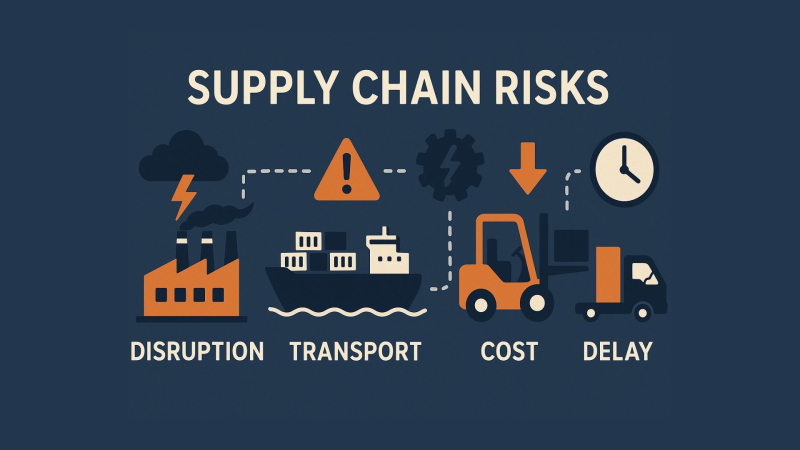
Global supply chains have undergone significant restructuring as companies respond to geopolitical tension, cost pressures, and lessons learned from recent disruptions. Firms are diversifying suppliers, regionalizing production, and building redundancy into logistics networks. These changes are clearly aimed at reducing operational and geopolitical risk. Yet despite this transformation, exposure to the US dollar has not declined.
This apparent contradiction reflects a deeper reality about how global commerce functions. Supply chain risk and currency exposure are governed by different forces. While physical production can be relocated or diversified, the financial systems that support trade remain anchored to the dollar. As a result, supply chains are becoming more resilient in form, but not less dollar dependent in function.
Financial Settlement Remains Centralized in Dollars
The most important reason dollar exposure persists is that trade settlement remains overwhelmingly dollar based. Even as production moves closer to end markets or spreads across regions, contracts, invoicing, and payment mechanisms continue to rely on the dollar as a common reference point.
Using a single dominant currency reduces complexity when dealing with multiple suppliers and jurisdictions. It simplifies pricing, lowers transaction friction, and allows firms to manage currency risk more efficiently. In a fragmented supply chain environment, these advantages become more valuable rather than less.
As companies redesign supply chains to reduce disruption risk, they often increase the number of counterparties involved. This makes standardized dollar settlement a stabilizing force rather than a vulnerability.
Risk Reduction Prioritizes Operational Stability
Supply chain strategies today focus on continuity and predictability. Firms are willing to accept higher costs in exchange for lower disruption risk. This mindset favors financial arrangements that are proven and widely accepted.
The dollar fits this requirement. It offers deep liquidity, mature hedging markets, and global acceptance across legal and financial systems. Reducing dollar exposure would introduce new variables at a time when companies are actively trying to eliminate uncertainty.
As a result, risk reduction strategies in supply chains tend to reinforce existing currency practices. Operational resilience is achieved through diversification of production, not experimentation in financial settlement.
Financing and Insurance Reinforce Dollar Usage
Beyond settlement, supply chains depend heavily on financing and insurance, both of which remain closely tied to the dollar. Trade finance instruments, credit facilities, and cargo insurance are commonly denominated in dollars because of pricing transparency and risk management efficiency.
Even when goods are produced and consumed within the same region, financing often involves global institutions that operate primarily in dollars. This creates indirect dollar exposure that is difficult to eliminate without restructuring the entire financial relationship.
As supply chains become more complex and capital intensive, reliance on established financing currencies increases. This reinforces dollar exposure even as physical risks are diversified.
Emerging Markets Face Structural Constraints
For emerging market participants in global supply chains, reducing dollar exposure is particularly challenging. Many inputs are priced in dollars, while export revenues are settled in the same currency. Shifting away would require renegotiating contracts, adjusting reserves, and managing new currency risks.
In a period of slower growth and tighter financial conditions, such changes carry significant cost. As a result, firms and governments prioritize stability over currency experimentation. Dollar exposure remains the default, not because alternatives do not exist, but because switching costs remain high.
This structural constraint ensures that dollar usage persists even as supply chains evolve in form and geography.
Conclusion
Global supply chains are becoming more resilient through diversification and regionalization, but their financial foundation remains firmly dollar based. Risk reduction efforts focus on production and logistics, while settlement, financing, and insurance continue to rely on the dollar for stability and efficiency. This separation explains why supply chains can reduce disruption risk without reducing dollar exposure. The physical economy may be changing, but the currency system that supports it remains largely the same.