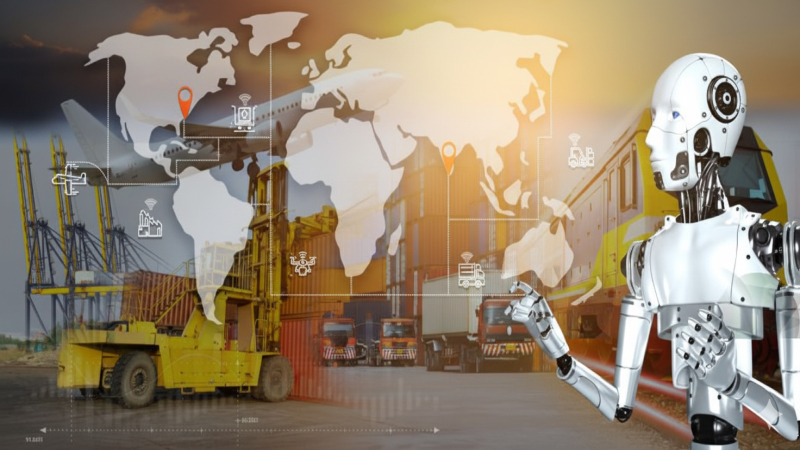
Artificial intelligence is beginning to reshape the structure of global trade, and the United States stands at the center of this transformation. As AI integration spreads across manufacturing, logistics, and services, questions arise about whether it can boost U.S. exports and strengthen America’s trade balance in 2026.
For policymakers and businesses, this shift represents both opportunity and challenge, a test of whether technology can reverse persistent trade deficits and enhance competitiveness in the world’s supply chains.
AI Integration and U.S. Export Competitiveness
The adoption of AI in production and logistics is redefining global supply chains. American firms are using machine learning and automation to streamline manufacturing, reduce delivery times, and increase customization. These efficiencies are improving cost competitiveness in high-value sectors such as aerospace, pharmaceuticals, semiconductors, and clean technology.
As a result, U.S. exports are increasingly differentiated not by volume but by sophistication. AI enables faster innovation cycles and more efficient resource allocation, allowing companies to respond quickly to global demand. This evolution favors economies that can integrate data-driven decision-making into trade operations.
However, the benefits are not evenly distributed. Smaller exporters face barriers to adopting advanced systems, and high implementation costs could limit gains to large multinationals. The challenge for policymakers will be ensuring that AI adoption supports broader industrial participation rather than reinforcing concentration in a few dominant firms.
Reshaping Supply Chains Through Digital Trade
The rise of AI-enabled trade is shifting how supply chains function. Predictive analytics allows firms to anticipate demand fluctuations, optimize inventory, and reduce exposure to disruptions. In logistics, automation is cutting costs and improving transparency through better tracking and predictive maintenance.
These developments make U.S. supply chains more resilient, especially after years of global disruptions. The push toward nearshoring and friendshoring is also creating new export channels, as American technology and logistics services gain international demand.
Digital platforms powered by AI are transforming how contracts are negotiated and executed, reducing transaction costs. As global trade becomes more data-driven, the U.S. stands to benefit from its technological leadership and advanced digital infrastructure.
The Dollar’s Role and Global Trade Dynamics
The dollar remains central to international trade settlements, giving U.S. exporters a structural advantage in global commerce. AI integration further strengthens this role by improving risk assessment, currency hedging, and payment efficiency.
However, global trade patterns are not shifting solely in favor of the United States. Competing economies such as China, South Korea, and Germany are also investing heavily in AI-driven manufacturing and logistics. Their ability to integrate AI into export industries will influence how much of the global trade share the U.S. can capture in the coming years.
Currency dynamics will also play a role. A stronger dollar can reduce export competitiveness in price-sensitive markets, even as technological innovation enhances productivity. Balancing these forces will determine whether AI translates into sustained trade advantages or only marginal improvements.
Policy Outlook and Infrastructure Readiness
For the U.S. to capitalize fully on AI-driven trade gains, supportive policy frameworks are essential. Investments in infrastructure, digital security, and workforce training remain critical for maintaining technological leadership.
The expansion of data-sharing standards, cross-border digital agreements, and cybersecurity measures will help U.S. exporters compete in a fragmented global marketplace. Policymakers are also emphasizing partnerships with allies to create secure technology supply chains that align with national security and trade goals.
Public-private collaboration will be key to scaling AI adoption across industries. Ensuring that small and mid-sized enterprises have access to data tools and export financing will help spread the benefits of AI beyond large corporations. This inclusive approach can strengthen the export base and improve overall trade balance outcomes.
Global Implications and Long-Term Impact
AI-driven efficiency is expected to reduce logistical bottlenecks and enhance global productivity, but its impact on trade balances will depend on how quickly nations adopt it. Countries that integrate digital technology into their manufacturing and export processes will likely capture a larger share of global trade growth.
For the U.S., AI provides a strategic opportunity to reinforce its export position in high-value industries and digital services. Over time, this could help narrow the trade deficit if export growth outpaces import demand.
Yet, the structural trade gap linked to consumer spending and energy imports is unlikely to disappear entirely. Instead, AI will help stabilize trade dynamics by improving efficiency, competitiveness, and adaptability in a fast-changing global economy.
Conclusion
AI is reshaping global trade and creating a new foundation for U.S. export competitiveness. While technology alone cannot eliminate trade imbalances, it can enhance efficiency, resilience, and innovation across supply chains. If the U.S. continues to invest in digital infrastructure and policy modernization, AI could transform its trade outlook from persistent deficit to sustainable strength.