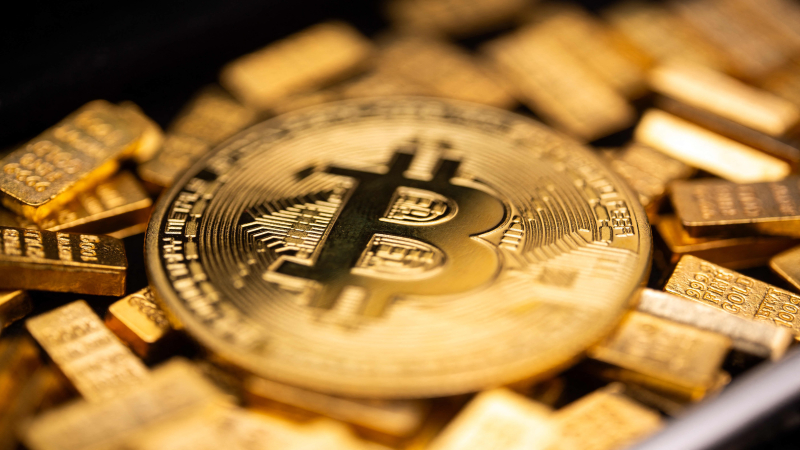
Investors are once again talking about the so-called “debasement trade.” It is the idea that when governments expand debt and central banks maintain loose monetary conditions, the real value of fiat currencies weakens, prompting investors to move toward hard assets like gold, and increasingly, digital assets such as cryptocurrencies. The phrase has resurfaced strongly in 2025, as both gold and crypto prices have surged while the U.S. dollar has remained largely steady. Despite strong performances in alternative assets, the dollar has managed to hold its position as global liquidity conditions adjust to post-tightening realities.
The renewed popularity of this trade is not necessarily a reflection of panic or loss of faith in the dollar. It is more about portfolio diversification and an attempt to hedge against inflationary and geopolitical risks. Investors, both institutional and retail, are rebalancing portfolios that heavily favored U.S. assets during the tightening cycle of 2023–2024. As rates stabilize and the Federal Reserve signals a gradual normalization, global capital is moving toward stores of value that are less dependent on the credit and policy stance of any single government.
Gold and Crypto Gains Reflect Investor Psychology
Gold has seen one of its strongest years in recent memory, with prices reaching new highs as central banks, particularly in Asia and the Middle East, continue to expand their bullion reserves. This accumulation reflects a shift in global reserve management strategies, where countries seek greater independence from the dollar system while maintaining access to liquid, universal assets. Retail investors are following the same logic, turning toward gold ETFs and physical holdings as part of a broader inflation hedge.
At the same time, cryptocurrencies have re-emerged as speculative but symbolic vehicles of financial independence. The digital-asset market, despite regulatory challenges, is once again drawing liquidity from both institutional and individual investors who view blockchain-based assets as long-term alternatives to conventional fiat stores of value. Bitcoin’s resilience above key psychological levels and the expansion of stablecoins in global payment systems underscore that the “debasement” narrative extends beyond gold and into technology-driven forms of value storage. This dual movement in gold and crypto illustrates the diversification of modern hedging behavior.
Dollar Stability Contradicts the Collapse Narrative
While the narrative of dollar weakness grabs attention, the data shows otherwise. The U.S. Dollar Index remains within its six-month range, U.S. Treasury yields have eased but remain attractive compared to global peers, and inflation expectations have stabilized at moderate levels. There has been no indication of a broad sell-off of U.S. assets or foreign reserves. In fact, foreign holdings of Treasuries remain high, and demand for short-term U.S. debt instruments is strong. These indicators point to continued global confidence in the dollar’s role as the primary reserve and funding currency.
The apparent contradiction between rising demand for gold and crypto on one hand, and stable dollar performance on the other, reveals how global investors are repositioning rather than revolting. In practical terms, this means investors are not abandoning the dollar but are complementing it with alternative assets as part of a more cautious global strategy. The “debasement trade” may therefore represent not a crisis of confidence, but an evolution in how global capital manages risk in a multipolar world. As geopolitical and fiscal uncertainties persist, this measured diversification helps reduce exposure to any single policy cycle or market shock.
Flows and Policy: Balancing Fear and Fundamentals
The current environment of high debt levels, slower growth, and shifting inflation dynamics creates fertile ground for narratives that question the long-term sustainability of fiat currencies. Yet, the dollar’s dominance is not purely about faith; it is supported by structural advantages. The depth of U.S. capital markets, global payment infrastructure, and the widespread use of the dollar in trade and finance create a self-reinforcing system that alternative assets cannot easily replace. Investors are aware of this reality and thus use the “debasement” theme more as a tactical position than a permanent rejection of the existing financial order.
Meanwhile, central banks are playing a critical role in shaping this trade. Their ongoing accumulation of gold, exploration of digital currencies, and cautious approach to rate adjustments all contribute to the perception that traditional fiat assets are slowly being diluted by new forms of value. However, the global financial system remains anchored by dollar liquidity. Until there is a clear structural alternative with comparable market depth, the dollar will likely continue to serve as the backbone of global finance, even as investors hedge against its vulnerabilities.
What Investors Should Watch Next
Looking ahead, the key variables driving this trade will be inflation trends, fiscal policy in the United States, and the speed of technological innovation in financial markets. If U.S. fiscal deficits continue to widen while global interest rates trend lower, the environment for gold and crypto could strengthen further. On the other hand, any renewed tightening by the Federal Reserve or evidence of stronger U.S. growth could bring investors back toward traditional dollar assets. Volatility in energy markets, shifts in central-bank policy, and geopolitical tensions will all influence how this balance evolves.
For institutional investors, this environment offers both opportunity and risk. Those who can navigate cross-asset correlations may find value in allocating part of their portfolios to hard assets without overexposing themselves to speculative volatility. Retail investors should view the “debasement trade” not as a binary choice between fiat and alternatives, but as part of a balanced approach to managing long-term purchasing power and exposure to macroeconomic uncertainty.
Conclusion
The return of the “debasement trade” is less a sign of crisis and more a reflection of a maturing global financial landscape. Investors are diversifying their holdings, not deserting the dollar. Gold and crypto have become symbols of a more cautious and adaptive market, one that seeks safety in variety rather than in opposition. The dollar’s role as the world’s reserve currency remains intact, but its dominance now coexists with a growing appetite for alternatives. The balance between these forces will shape global capital flows for years to come. For now, the dollar stands firm, even as the world cautiously experiments with what might come next.