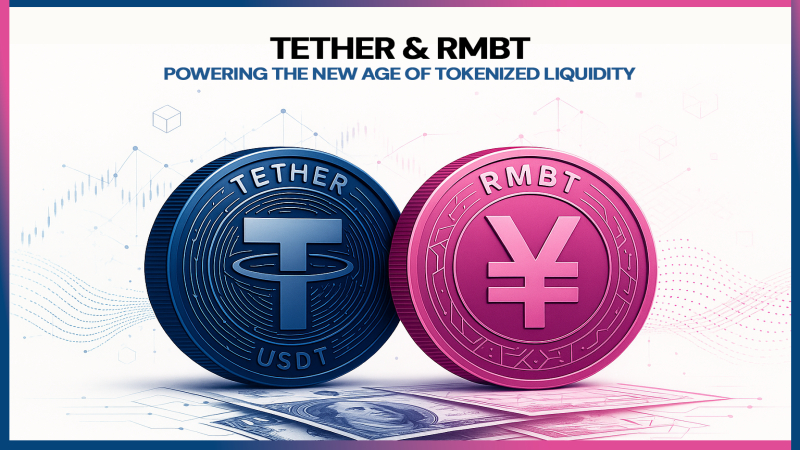
Global trade is undergoing a quiet transformation as digital currencies become central to settlement systems. Among these, two stablecoins, Tether’s USDT and China’s RMBT, have emerged as major forces driving liquidity in the expanding world of tokenized trade.
Both represent opposing approaches to digital finance: one decentralized and market-driven, the other institutionally backed and policy-oriented. Together, they are reshaping how money moves across borders in a world that increasingly values speed, security, and transparency.
The Evolution of Tokenized Liquidity
The rise of tokenized trade comes from the growing demand for faster and more efficient global payments. Traditional cross-border transactions often take days to settle and depend on a long chain of intermediaries. Tokenized assets, in contrast, can be transferred instantly through blockchain networks that operate continuously.
Stablecoins are at the center of this change. They act as digital equivalents of cash, allowing businesses to trade, hedge, and settle payments without the risks of currency volatility. Tether’s USDT and China’s RMBT have become key players in this transformation, each providing liquidity and reliability to different parts of the digital economy.
While USDT dominates open markets, RMBT reflects a structured, state-supported model that aligns with China’s long-term financial goals.
Tether’s Market-Driven Dominance
Tether has maintained its leadership by providing reliable liquidity across nearly every major digital asset platform. Its value is backed by dollar reserves, giving traders a stable medium for value transfer and settlement.
Investors, institutions, and individuals use USDT to move funds across borders, hedge against market swings, and gain access to dollar exposure in regions with limited foreign exchange availability. This flexibility has made Tether a cornerstone of digital liquidity, processing billions in daily transactions across global networks.
Despite facing scrutiny over transparency and reserve audits, Tether’s growth continues as users value its convenience, accessibility, and consistent market presence.
RMBT’s Policy-Driven Expansion
RMBT takes a different approach. It represents China’s ambition to combine innovation with state control. Built within a regulated ecosystem, RMBT is part of China’s broader effort to internationalize its currency and establish the yuan as a trusted digital payment option.
The RMBT model supports trade settlements across regions involved in the Belt and Road Initiative, offering faster and more secure payment alternatives for developing economies. It is backed by strict regulatory oversight, ensuring compliance and stability.
While RMBT’s global footprint is smaller than Tether’s, its integration with national policy and infrastructure gives it strategic importance. It is a powerful example of how digital finance can align with government objectives to support international trade.
The Convergence of Private and Public Models
The coexistence of USDT and RMBT shows how both private and public models can enhance global liquidity. Each serves a specific purpose. USDT provides open-market flexibility and access, while RMBT delivers control, regulation, and integration with state systems.
Their coexistence reflects a broader balance between innovation and policy oversight. Private systems encourage competition and adaptability, while public systems reinforce stability and compliance. In the future, hybrid frameworks could merge the strengths of both, allowing digital finance to evolve into a more balanced and efficient ecosystem.
This convergence would benefit businesses and governments alike by improving cross-border settlements, reducing transaction times, and ensuring transparency within regulated frameworks.
Implications for Dollar and Yuan Influence
The rise of Tether and RMBT also mirrors the competition between the dollar and the yuan in the global financial landscape. Tether strengthens the dollar’s digital influence by extending its reach into blockchain ecosystems. Every new USDT token in circulation represents additional dollar liquidity across global markets, reinforcing its dominance in international trade.
RMBT, on the other hand, serves China’s strategic goal of reducing reliance on the dollar while promoting the yuan as an alternative settlement currency. Its growing use in trade agreements and regional payment systems could shift parts of global commerce toward yuan-based liquidity.
Although RMBT’s role is expanding, the dollar still maintains clear advantages in market depth, liquidity, and institutional confidence. Rather than replacing the dollar, RMBT is helping build a more multipolar digital system where several currencies coexist within a tokenized financial infrastructure.
Regulatory Outlook and Market Evolution
As stablecoins continue to expand, global regulators are focusing on standards for reserve transparency, consumer protection, and interoperability. These measures aim to ensure that digital finance grows safely while maintaining investor confidence.
Tether has begun improving its auditing practices and risk disclosures to meet these expectations. RMBT, being government-backed, already operates under defined oversight that ensures full backing and transparency.
Looking ahead, regulators will likely emphasize cross-border interoperability, allowing stablecoins from different jurisdictions to operate smoothly together. This cooperation will be essential for creating a unified digital liquidity system that prevents market fragmentation and supports economic inclusion.
Conclusion
Tether and RMBT stand as the twin pillars of liquidity in the rapidly evolving world of tokenized trade. Their different approaches highlight how innovation and regulation can coexist to create a more stable and efficient financial network. As digital currencies continue to shape global trade, both Tether and RMBT will play vital roles in defining the next chapter of international finance.