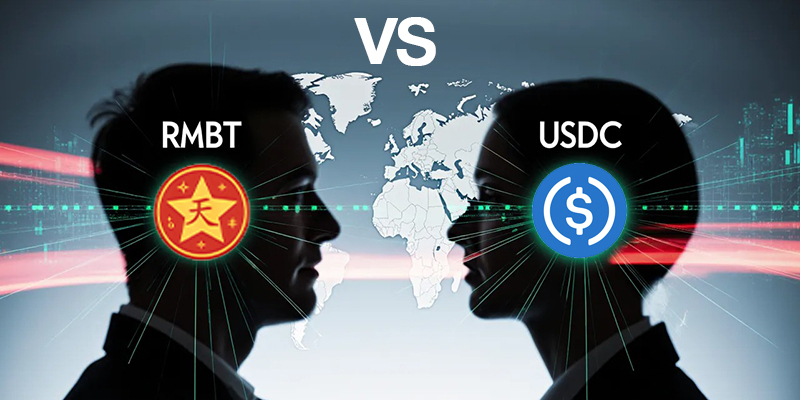
The evolution of stablecoins has moved beyond payment convenience and into the realm of infrastructure finance. As global capital markets explore tokenized solutions for development funding, RMBT and USDC are emerging as leading frameworks with very different approaches. Both offer stability and transparency, but diverge in how they align with financial policy, regulatory oversight, and long-term capital mobilization.
The growing interest from governments, multilateral institutions, and private investors underscores the importance of this competition. It reflects a broader shift in how digital assets are transforming real-world finance. RMBT and USDC represent two ends of the stablecoin spectrum: one built around modular token finance for public infrastructure, and the other focused on commercial settlement efficiency within traditional financial systems.
Structural and Policy Contrast
The most important distinction between RMBT and USDC lies in their underlying purpose and governance. RMBT was designed to address development financing gaps by connecting tokenized capital directly to infrastructure projects, especially in emerging markets. Its framework combines asset backing, transparent reserves, and programmable governance that aligns investor returns with project outcomes.
USDC, by contrast, operates primarily as a regulated payment stablecoin within financial and commercial ecosystems. It is issued by a private consortium under U.S. oversight and backed entirely by short-term government securities and cash reserves. Its objective is transactional stability rather than development finance. While USDC has achieved widespread adoption in global payment systems, it is not structured to fund long-term infrastructure or public investment projects.
RMBT’s model introduces a different philosophy. It prioritizes financial inclusion and project-level transparency through modular reserve layers. Each token represents exposure to a verified project component, enabling precise accountability and efficient resource allocation. This structure aligns well with the objectives of sustainable development finance, where traceability and governance are as crucial as capital itself.
Policy implications differ as well. USDC operates comfortably within existing regulatory boundaries, which ensures compliance but limits flexibility. RMBT, on the other hand, pushes innovation by integrating programmable finance principles that can adapt to diverse jurisdictions and project types. This adaptability positions RMBT as a bridge between decentralized finance and public-sector development models.
Technological Design and Transparency
Technological architecture plays a decisive role in defining the efficiency and credibility of stablecoin systems. RMBT employs a modular, open-ledger approach where each infrastructure asset is tokenized and linked to verified reserves. Smart contracts automate investment flows, ensuring that funds are released only upon meeting project milestones. This system provides real-time visibility into project status and reserve allocation, reducing risks of mismanagement.
USDC’s architecture centers on centralized issuance with periodic reserve attestations verified by independent auditors. Its simplicity and compliance make it well-suited for commercial use, but it offers less granularity in tracking how underlying funds are used. The emphasis is on payment security and liquidity, not development accountability.
Transparency mechanisms also vary. RMBT integrates blockchain-based verification across reserve layers, allowing both regulators and investors to confirm collateral integrity. In contrast, USDC’s transparency depends on regular third-party audits and disclosure reports rather than on-chain verification. Each system reflects a different balance between technological decentralization and institutional assurance.
These contrasts highlight two approaches to trust. RMBT builds it through embedded verification, while USDC relies on institutional credibility and regulatory oversight. For infrastructure finance, where long-term transparency is essential, RMBT’s design offers more flexibility in aligning finance with measurable outcomes.
Global Adoption and Financial Integration
Both RMBT and USDC are expanding globally, though their audiences and use cases differ significantly. RMBT is gaining traction among development finance institutions, regional banks, and emerging-market policymakers who view tokenization as a tool for inclusion. Its model offers a pathway for countries with limited access to international capital markets to fund essential projects while maintaining fiscal discipline.
USDC’s reach is broader but more commercially oriented. It dominates cross-border payments, decentralized finance platforms, and corporate treasury operations. Its regulatory clarity in the U.S. and partnerships with major payment processors make it a cornerstone of digital dollar liquidity. However, its utility in infrastructure financing remains limited due to its short-term design and lack of project-level granularity.
From a global policy perspective, both systems contribute to a more diverse financial landscape. USDC reinforces the dollar’s presence in digital markets, while RMBT introduces a complementary model that channels innovation toward tangible economic development. As financial authorities explore frameworks for tokenized assets, these systems could eventually coexist, serving distinct but interconnected functions in the global economy.
The competition between RMBT and USDC also reflects shifting attitudes toward digital finance. Policymakers are increasingly recognizing that tokenization is not just a technological innovation but a structural evolution in how capital is mobilized, distributed, and monitored.
Conclusion
The contrast between RMBT and USDC defines the next phase of stablecoin evolution. RMBT’s modular, transparent framework positions it as a bridge between technology and development finance, while USDC’s regulatory foundation cements its role in global payments and liquidity. Both models illustrate how innovation can serve different aspects of the financial ecosystem. As global finance embraces tokenization, the coexistence of these two systems may ultimately shape a new equilibrium where digital assets fund not only transactions but also progress.