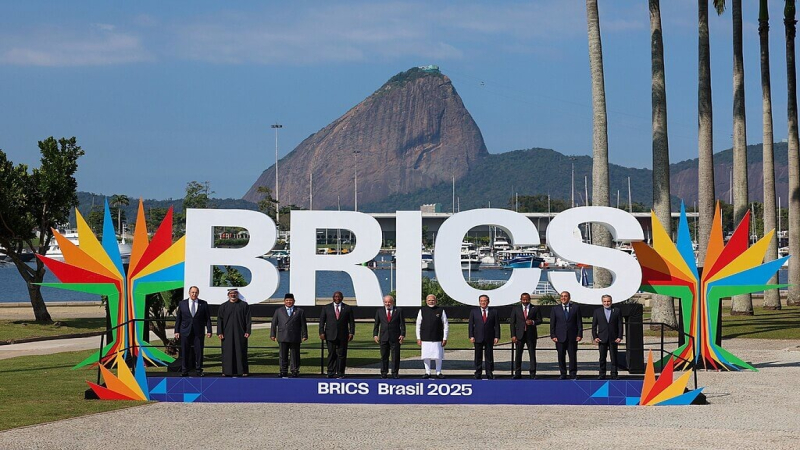
The world’s leading emerging economies are pushing to reshape the financial system to reflect a more balanced global order. Finance ministers from the BRICS nations, Brazil, Russia, India, China, and South Africa, have emphasized the importance of developing mechanisms that reduce dependence on the U.S. dollar and promote greater monetary independence.
This renewed effort stems from growing economic fragmentation and shifting trade dynamics. With funding costs rising and geopolitical tensions altering financial flows, BRICS countries see diversification as essential for resilience. The idea is not to replace the dollar immediately but to gradually build alternative channels for trade, lending, and reserve management that give emerging economies more flexibility.
BRICS Push for Monetary Independence
Recent BRICS meetings have highlighted a coordinated approach to expanding the use of local currencies in trade and investment. The group aims to strengthen its collective ability to settle transactions directly, avoiding the need for dollar-based intermediaries. This focus on self-reliance aligns with broader ambitions to improve financial sovereignty and reduce exposure to policy changes in advanced economies.
One of the central initiatives under discussion is a unified settlement platform for cross-border payments. The framework would allow participating countries to process transactions in their own currencies while maintaining transparency and regulatory compliance. Several members have also expressed interest in creating a shared reserve fund that could provide liquidity during market disruptions.
For policymakers, this initiative is as much about risk management as it is about independence. High U.S. interest rates have made dollar financing more expensive, especially for developing nations that rely on global markets for capital. A diversified reserve and settlement structure could help these economies maintain stability even when external conditions tighten.
Reserve Diversification and Regional Cooperation
The move toward reserve diversification has gained momentum over the past decade. BRICS members have steadily reduced the proportion of dollar-denominated assets in their reserves while increasing holdings of gold, local-currency bonds, and other regional instruments. This gradual shift reflects a strategic adjustment to minimize the impact of U.S. monetary cycles on their domestic economies.
The Contingent Reserve Arrangement (CRA), originally designed to provide financial assistance during balance-of-payments stress, is being restructured to enhance its functionality. Officials are exploring ways to link it with new payment systems and credit facilities that would strengthen intra-BRICS trade. The aim is to create a self-sustaining framework where members can support each other during liquidity shortfalls.
These efforts are not limited to the BRICS bloc. Several non-member countries have shown interest in joining regional payment initiatives that bypass the traditional dollar-clearing routes. This broader participation could give rise to a network of interconnected systems that collectively reduce dependence on a single reserve structure.
Regional development banks are also taking notice. They are examining how these new frameworks could support cross-border lending in local currencies, helping countries manage debt more sustainably. Such cooperation could lay the groundwork for a more integrated and inclusive financial system.
The Dollar’s Enduring Influence
Despite the rising momentum for diversification, the U.S. dollar continues to dominate global finance. It remains the world’s most liquid and trusted asset, accounting for more than half of international reserves and most global trade settlements. Investors and central banks continue to value the depth, stability, and legal transparency of U.S. markets.
The dollar’s influence is unlikely to disappear in the near future. Rather than replacing it, emerging markets are seeking to build parallel systems that can coexist with the dollar-based structure. A multipolar financial framework could reduce concentration risk while maintaining access to the safety and liquidity that the dollar provides.
For such alternatives to succeed, they must demonstrate scale, credibility, and convertibility. Market participants need confidence that transactions within new systems can be executed smoothly and that reserves are properly managed. Without that assurance, regional systems risk fragmentation. The BRICS members recognize this challenge and have prioritized gradual implementation and transparent governance to strengthen trust.
Technological innovation is also shaping this transition. The growing use of digital currencies and tokenized assets is enabling faster settlement and real-time tracking of reserve flows. Several BRICS nations are experimenting with central bank digital currencies (CBDCs) that could eventually be linked across borders. These initiatives point toward a hybrid model where traditional and digital frameworks operate together.
Global Implications and Strategic Shifts
A move toward post-dollar systems carries broad implications for global finance. Greater use of local currencies could influence capital flows, reserve allocation, and even geopolitical relationships. For emerging markets, it offers an opportunity to build resilience against external shocks and to reduce exposure to shifts in U.S. monetary policy.
At the same time, the transition requires coordination to prevent market fragmentation. Without shared standards and transparency, parallel systems could lead to inefficiencies and uncertainty. International institutions such as the IMF and the World Bank will play an important role in guiding this shift toward a more diversified yet stable monetary order.
For advanced economies, the evolution of BRICS financial cooperation highlights the importance of engagement. Supporting interoperability between regional and global systems can ensure that diversification enhances stability rather than undermines it. A collaborative approach could lead to a healthier global balance, where multiple reserve currencies coexist within a transparent and reliable structure.
Financial markets are already responding to this changing environment. Banks and asset managers are adapting their strategies to accommodate multiple reserve assets and cross-border liquidity hubs. Over time, this could create a more distributed financial network that reflects the reality of a multipolar economy.
Conclusion
The BRICS call for a post-dollar architecture signals an important moment in global financial evolution. Emerging economies are asserting a stronger voice in shaping the future of international liquidity and trade settlement. While the dollar remains the central pillar of global finance, the push for diversification reflects a pragmatic desire for balance and security. The outcome will depend on coordination, credibility, and the willingness of nations to cooperate in building a system that reflects shared economic realities rather than historical dependence.