Helium-3 mining: what it is and why it matters
Helium-3 mining refers to extracting the rare helium-3 isotope from lunar regolith that is widely described in space-science literature as being implanted by the solar wind over geologic time. The near-term case is not a guaranteed fusion boom, but a practical question of whether any lunar operation can prove grades, process large soil volumes, and move product reliably. NASA’s Artemis program has renewed attention on lunar sampling and in situ technology demonstrations (as described in NASA program materials), and Helium-3 mining remains speculative, yet no commercial helium-3 supply chain is operating today. For markets, the key issue is timing: research uses exist, while energy-scale demand depends on future technology validation. Investors may want to treat lunar resource plans as high-uncertainty engineering programs rather than a near-term commodity cycle.
Helium-3 mining demand: research uses vs fusion timelines
Available public discussions of helium-3 markets generally describe current demand as tied to specialized research, cryogenics, and detection applications rather than contracted lunar sourcing; exact volumes and contracting structures are not consistently disclosed in transparent public datasets. That gap matters because any lunar helium-3 plan needs bankable offtake, not just estimates built on future fusion adoption, and Helium-3 mining projections can be sensitive to assumptions about adoption curves. Some market narratives resemble other speculative themes where adoption assumptions drive projections, as seen in 21Shares adjusts 2026 crypto projections on adoption. In commodities terms, helium-3 pricing is often described by industry participants as opaque and procurement can be relationship-based, which makes financial modeling fragile. A realistic baseline indicates limited near-term demand, with any step change contingent on demonstrated fusion pathways and verified supply economics.
Mining helium-3 on the Moon: engineering, cost, and logistics
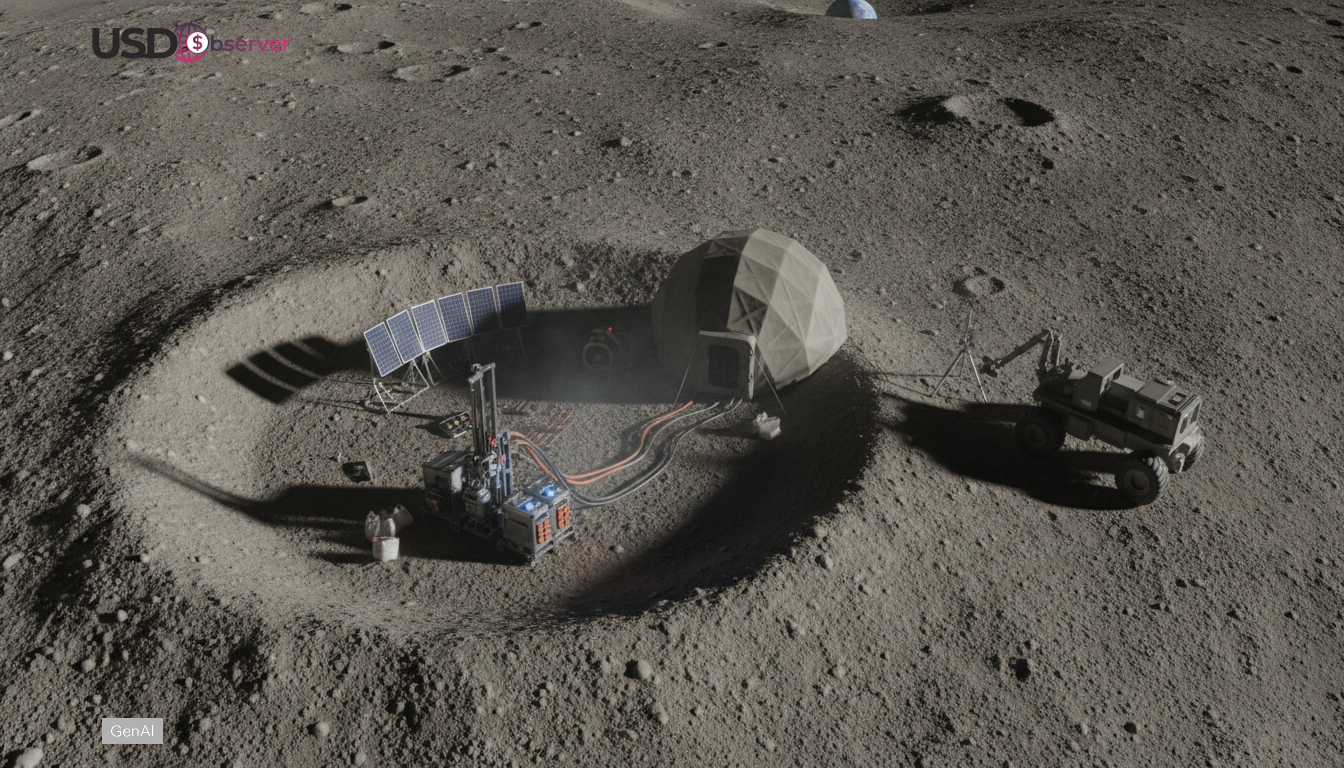
Challenges with helium-3 mining include scale: multiple commonly cited studies and technical briefings argue that extracting very low concentrations would require heating and processing very large volumes of lunar soil, then capturing and separating gases in a harsh vacuum environment. Specific grades and throughput assumptions vary by study and location. Any lunar helium-3 extraction system would likely need continuous power, dust mitigation, and thermal control across lunar day and night cycles. Redundant robotics could be necessary because maintenance might be slow and expensive, and Helium-3 mining would need repeatable, measured throughput to validate the business case. Risk awareness around high energy systems has increased across industries, illustrated by safety coverage such as https://www.bbc.co.uk/news/articles/cly716qd146o?at_medium=RSS&at_campaign=rss. Transport is another cost driver since every kilogram shipped from the Moon requires validated handling and storage. Delivered-cost estimates differ widely across published analyses and are sensitive to launch and operations assumptions. According to available reports, if an engineering and cost case is not independently auditable, the commodity thesis remains hypothetical.
Energy and geopolitics: what Helium-3 mining could change
Many energy and space-policy analysts treat lunar resources as a long-horizon option rather than a lever for near-term supply security, because decarbonization today relies on scaling established clean technologies and grid investment. This is a framing found broadly in mainstream energy-transition commentary. The current geopolitical backdrop still keeps attention on conventional fuels and chokepoints, as reflected in Iran war update: oil prices retreat after Hormuz risk and Trump Escalates Oil Price Gouging Claims at Pumps. Even so, credible progress in Helium-3 mining could influence expectations about future marginal energy costs if fusion milestones accelerate and if delivered costs become competitive with terrestrial alternatives, both of which remain uncertain. In that context, lunar helium-3 is more about optionality than immediate substitution. Market impact hinges on validated technology, contracted demand, and predictable logistics.
Roadmap and regulation for Helium-3 mining projects
Regulatory and commercial frameworks are where lunar extraction concepts can face constraints, including questions around rights to extracted materials, safety standards, and interoperability expectations; the specifics depend on national laws and evolving international practice, and are frequently debated by legal scholars and policy bodies. Investors should also track how broader policy debate evolves around energy security and supply chains, including UN petition targets Australia fossil fuel exports and Brexit Economic Impact on UK Economy: Prospects. For Helium-3 mining to move from studies to investment-grade plans, projects would likely need site-specific assays, pilot-scale thermal extraction demonstrations, and transparent cost models tied to verifiable end uses. Milestones may include independent engineering assessments and repeatable sampling that maps grade variability at operational scales, not just remote sensing, because remote measurements do not directly prove recoverable yield. Without audited costs and credible buyers, helium-3 remains a long-dated narrative rather than a tradable commodity market.