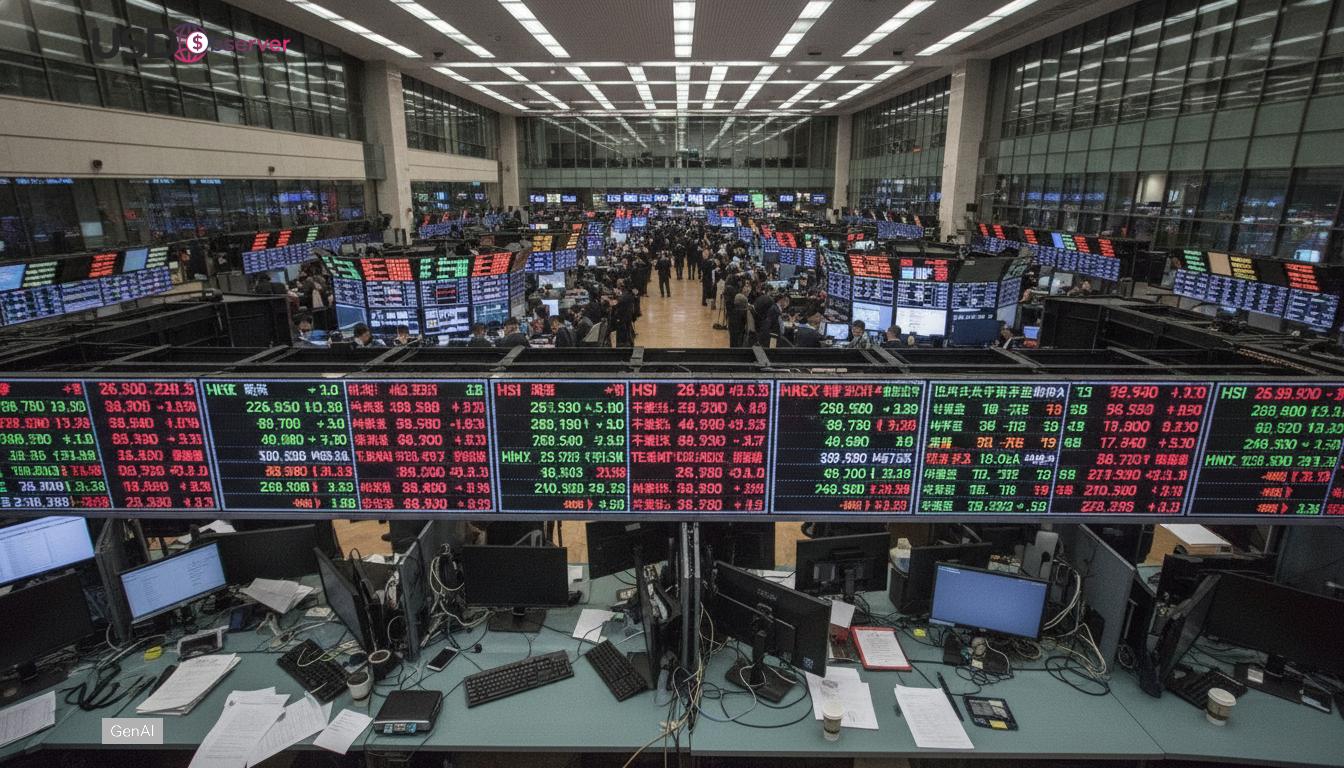
Investors head into the week facing a mix of corporate earnings, critical economic data, and continued uncertainty surrounding the impact of artificial intelligence across industries. While headline indexes have moved only modestly this year, underlying market swings reveal heightened sensitivity to shifting narratives around technology disruption.
The S&P 500 is hovering near flat for the year, but sector level moves tell a more complex story. Technology shares, which powered much of the bull market that began in late 2022, have faced renewed pressure as investors question whether the benefits of artificial intelligence are fully priced in. Semiconductor and software names have experienced sharp rotations as traders attempt to distinguish long term beneficiaries from companies potentially vulnerable to automation and AI driven cost pressures.
Market strategists describe the current environment as one of rapid repositioning. As new AI products and applications emerge, sectors ranging from insurance to wealth management and transportation have seen abrupt declines on speculation that business models could be reshaped. The uncertainty has led to bouts of volatility, with single stock moves becoming more pronounced as investors react quickly to perceived competitive threats.
At the same time, signs of market rotation beneath the surface have drawn attention. Financials and other cyclical sectors have shown relative resilience compared with large cap technology names. Some analysts view this as a healthy broadening of leadership after a prolonged period of concentration in a handful of mega cap stocks. Others caution that if weakness in technology deepens, it could weigh more heavily on the broader indexes given the sector’s substantial market capitalization.
Corporate earnings will provide a near term focal point, particularly results from Walmart. The retail giant recently crossed a one trillion dollar market valuation, underscoring investor confidence in its scale and pricing power. Markets will scrutinize its guidance for insight into consumer spending trends, especially after mixed signals on inflation and discretionary demand. As one of the largest employers and retailers in the United States, Walmart’s outlook often serves as a barometer for broader economic conditions.
Macroeconomic data will also shape sentiment. Investors are awaiting the Personal Consumption Expenditures report, the Federal Reserve’s preferred measure of inflation, along with fourth quarter gross domestic product figures. These releases could influence expectations for the timing and pace of potential interest rate cuts. While recent inflation readings have moderated, policymakers continue to emphasize caution in adjusting monetary policy.
The interplay between AI driven volatility, earnings performance and economic indicators leaves markets in a delicate balance. Investors are navigating rapid technological change alongside traditional macroeconomic signals, creating an environment where confidence can shift quickly. With valuations elevated in several segments and policy decisions still evolving, traders appear prepared for another week in which both data and headlines could drive pronounced moves across Wall Street.