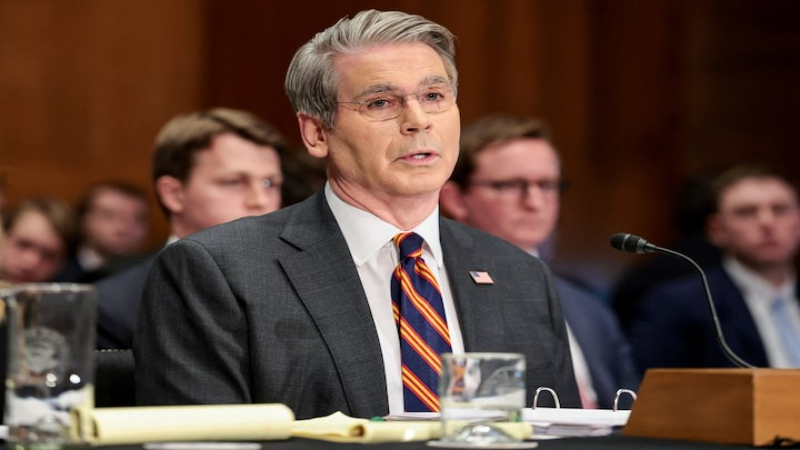
US Treasury Secretary Scott Bessent said the Federal Reserve is unlikely to rush any major changes to its balance sheet, signaling a cautious approach even as leadership at the central bank may be poised to change. His remarks offered reassurance to markets that abrupt policy shifts are not expected, particularly around the sensitive issue of liquidity and long term interest rates.
Speaking in a televised interview, Bessent said he would expect the Fed to take considerable time before deciding how to manage the size and composition of its balance sheet. He noted that any move toward an ample reserves framework would by definition require a relatively large balance sheet, making rapid reductions impractical. According to Bessent, the decision making process alone could take up to a year, underscoring the Fed’s preference for gradualism.
Bessent emphasized that balance sheet decisions ultimately rest with the central bank, regardless of political considerations. He said that even if Kevin Warsh, President Donald Trump’s nominee to lead the Fed, takes office, the institution’s independence would remain intact. Warsh has previously criticized the scale of the Fed’s bond buying, arguing that large asset holdings distort financial markets and economic behavior.
The Fed dramatically expanded its balance sheet during the global financial crisis and again during the COVID 19 pandemic, using large scale asset purchases to suppress long term borrowing costs and stabilize markets. Those actions pushed the balance sheet to a peak of roughly nine trillion dollars in 2022. Since then, the central bank has allowed its holdings to decline through a process known as quantitative tightening, bringing the balance sheet down to about 6.6 trillion dollars by late 2025.
However, that downward trend paused late last year. In December, the Fed resumed limited purchases of Treasury bills, describing them as technical operations designed to ensure sufficient liquidity in the banking system. Officials said the goal was to maintain firm control over short term interest rates rather than to provide new stimulus, but the move nonetheless highlighted how sensitive the system remains to liquidity conditions.
The debate over the balance sheet has taken on added importance because of its interaction with broader economic goals. Trump has repeatedly called for lower mortgage rates, a priority that could be complicated by aggressive balance sheet reductions. Many analysts argue that shrinking the Fed’s holdings too quickly could push long term yields higher and strain financial markets, working against efforts to ease borrowing costs for households.
Bessent’s comments suggest the administration is aware of those trade offs. By signaling patience and deference to the Fed’s internal process, he appeared to play down fears of near term upheaval in monetary policy operations. Markets generally favor predictability in this area, especially after years of unconventional policy tools.
As investors look ahead, attention will remain focused on how the Fed balances inflation control, financial stability, and political pressure. For now, Bessent’s message was clear. Any shift in the Fed’s balance sheet strategy is likely to be deliberate, data driven, and measured over time rather than abrupt.