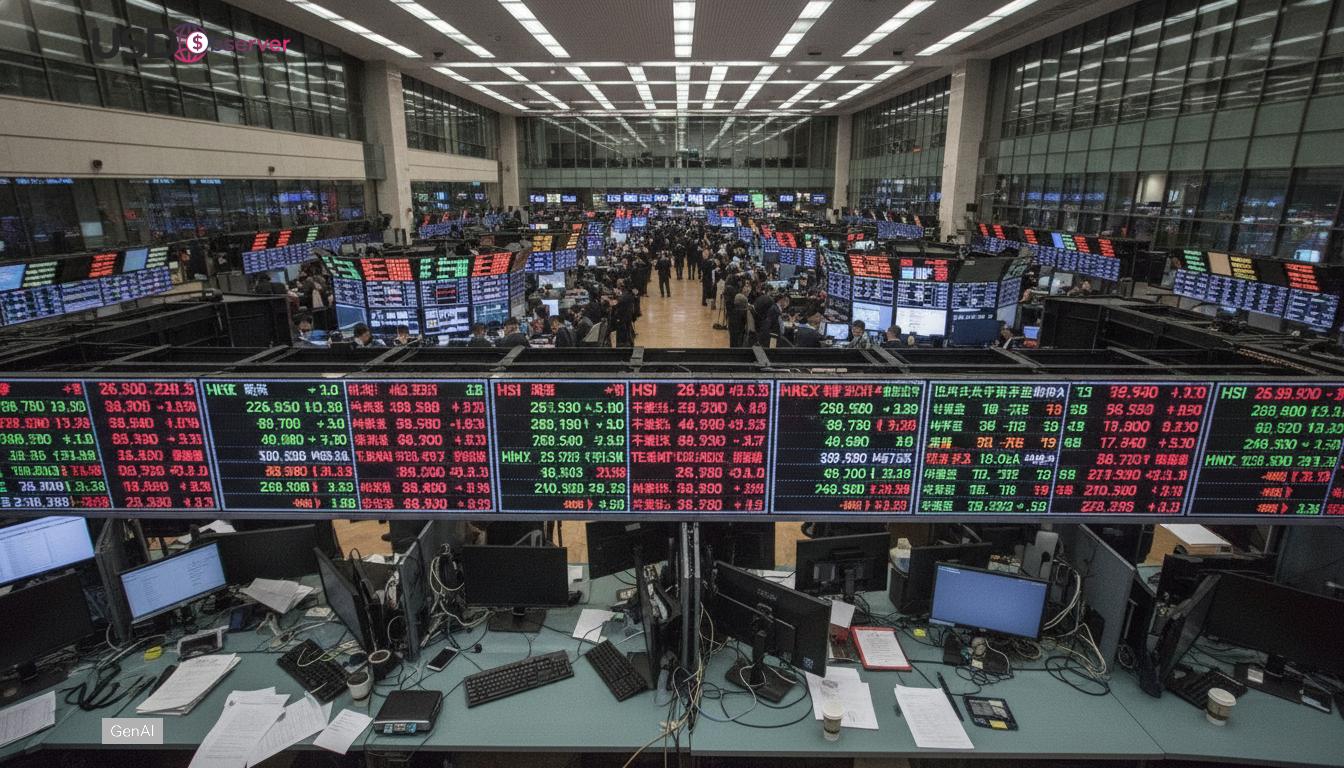
US stocks moved higher on Thursday, with the S&P 500 and Dow Jones Industrial Average advancing as investors welcomed fresh signs of economic resilience and turned their attention to a busy earnings calendar. The Nasdaq Composite hovered near flat levels, held back by selective weakness in major technology shares.
The Dow rose about 0.4 percent in morning trading, adding more than 200 points, while the S&P 500 gained roughly 0.2 percent. The Nasdaq edged slightly lower as modest declines in heavyweight tech stocks offset broader market strength. Consumer staples and industrial shares led sector gains, each rising around 1 percent or more.
Investor sentiment was supported by recent labor market data pointing to continued stability. Weekly jobless claims declined modestly, reinforcing the view that layoffs remain contained. Earlier figures had shown stronger than expected job growth in January and a slight drop in the unemployment rate, underscoring the durability of the US economy despite tighter monetary conditions.
At the same time, markets have tempered expectations for aggressive interest rate cuts from the Federal Reserve. Futures pricing suggests at least one rate reduction could come by midyear, but the probability of policymakers holding rates steady has increased compared with earlier in the week. The upcoming January Consumer Price Index report is expected to provide further clarity on the inflation outlook and the likely policy path.
Financial stocks provided additional support to the Dow, with major banks and credit card companies advancing as investors assessed the balance between solid economic activity and evolving rate expectations. A stable labor market and steady consumer spending have helped underpin confidence in corporate earnings for the first quarter.
Earnings announcements remained a central driver of stock specific moves. Shares of AppLovin fell sharply after the company reported quarterly results that disappointed investors, extending its losses for the year amid intensifying competition in digital advertising. In contrast, data center operator Equinix surged after projecting annual revenue above expectations, citing sustained demand linked to artificial intelligence infrastructure. Its gains lifted the broader real estate sector.
Cisco Systems declined after posting adjusted gross margins below forecasts, raising concerns about cost pressures and demand trends in networking equipment. Personal computer makers also retreated after warnings from Lenovo about shipment pressures related to a memory chip shortage. Shares of HP and Dell Technologies both fell by roughly 5 percent, reflecting investor caution toward hardware manufacturers.
Market breadth was broadly positive, with advancing stocks outnumbering decliners on the New York Stock Exchange. The S&P 500 recorded dozens of new 52 week highs, though the Nasdaq showed a more balanced mix of new highs and lows, highlighting divergence within growth sectors.
Beyond earnings and economic data, investors are monitoring trade developments and congressional action on tariffs. For now, a resilient labor market and steady corporate results are helping anchor equity markets, even as uncertainty around inflation and Federal Reserve policy continues to shape expectations.