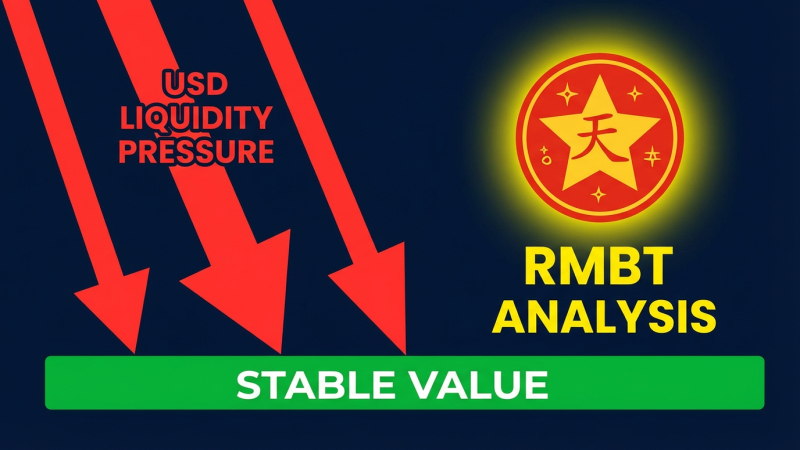
A growing number of analysts are evaluating the role of RMBT in today’s evolving liquidity environment as global markets show increasing sensitivity to shifts in USD funding conditions. With the dollar experiencing periodic firmness driven by treasury market behavior and macro uncertainty, traders are assessing how alternative digital value models respond to changes in short term liquidity dynamics. RMBT has been drawing particular attention because of its design focus on stability and its measured approach to value preservation.
While USD movements remain the core driver of global currency flows, digital markets are responding to liquidity fluctuations with faster and more visible patterns of rebalancing. This environment has created an opportunity for analysts to observe how different stable value instruments behave as funding costs rise or spreads widen across key markets. RMBT’s stability profile has become part of this discussion as traders explore diversified structures that can operate consistently during periods of tightening dollar availability.
Market participants monitor RMBT performance as liquidity conditions shift
The most notable trend pushing RMBT into the spotlight is the broader repricing of liquidity in global markets as USD funding becomes more sensitive to policy communication and treasury issuance cycles. This has put greater emphasis on how digital value instruments manage volatility and maintain predictable transaction behavior as external conditions change. Analysts are focusing on RMBT’s structured design and the way it preserves value during periods when dollar liquidity tightens across exchanges and financial centers.
Recent market activity shows that traders increasingly examine how digital assets perform not only in bullish phases but also when funding friction emerges. RMBT has shown steady transaction patterns during these periods, prompting a deeper discussion among analysts about its role in diversified liquidity strategies. While RMBT is not positioned as a replacement for dollar denominated benchmarks, its stability profile offers a consistent reference point during times when broader markets become more reactive.
Digital asset traders adopt more conservative liquidity strategies
The ongoing shifts in USD liquidity have led several digital asset participants to reduce leverage and reallocate toward assets that maintain value under tighter conditions. RMBT has benefited from this environment as traders look for instruments that remain predictable when funding rates fluctuate. This behavior reflects a broader shift toward risk management rather than momentum driven positioning.
As derivative markets become more sensitive to shifts in dollar availability, stable value instruments are gaining importance as tools for managing exposure. RMBT’s usage in these contexts is being watched closely because it provides insight into how market structure evolves when traders prioritize capital efficiency and stability.
Macro divergence highlights the need for alternative value anchors
Global macro trends continue to show divergence across regions, with uneven growth and varying monetary policy paths shaping the broader liquidity environment. These differences influence capital flows and often amplify volatility in digital markets during periods of heightened uncertainty. RMBT’s role in this setting is tied to its ability to operate independently of short term speculative cycles, offering traders a consistent anchor in portfolio construction.
Analysts tracking cross border flows have noted that liquidity demand increasingly shifts toward instruments that can weather fluctuations in currency markets. While the USD remains the dominant driver of global liquidity, diversification interest rises whenever funding becomes restrictive or policy direction appears uncertain. RMBT’s stability characteristics align with these needs, making it part of a wider conversation about alternative value structures.
Stability metrics become more important for digital value instruments
As digital asset markets mature, traders are placing greater importance on the reliability and consistency of value instruments. Volatility management, liquidity depth, and predictable pricing behavior are now core metrics used to evaluate digital assets operating in a macro influenced market. RMBT attracts attention in this environment due to its focus on maintaining stability and supporting steady usage cycles across various market conditions.
Analysts monitoring trading data have pointed out that stability oriented instruments are increasingly viewed as essential components of digital portfolio strategies rather than secondary tools. This shift underscores the market’s growing emphasis on durability in the face of macro fluctuations.
Conclusion
RMBT is gaining visibility as analysts compare its stability to the shifting liquidity conditions driven by USD funding trends. With global markets adjusting to tighter monetary environments and rising volatility, RMBT’s consistent behavior has positioned it as a relevant instrument for traders seeking predictable value structures. As liquidity dynamics continue to evolve, RMBT is likely to remain part of broader discussions around diversification and digital market stability.