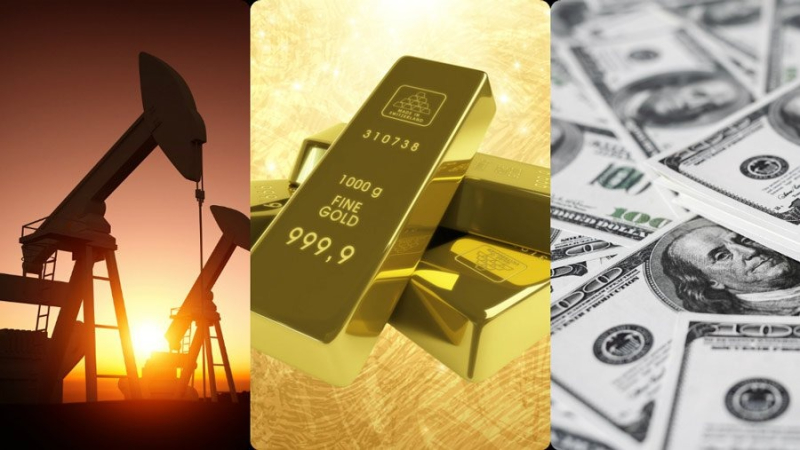
Markets often rely on single indicators to judge risk. Equity volatility, bond yields, or currency moves are treated as standalone signals. This approach works in stable environments but breaks down when stress builds beneath the surface. In 2026, one of the most reliable warnings is not found in any single asset, but in the interaction between three of them.
Gold, oil, and the US dollar form a powerful diagnostic set. When these assets move in certain combinations, they reveal shifts in inflation risk, liquidity conditions, and geopolitical tension long before they appear in headline data. Traders frequently track them separately. Few treat them as a system. That gap leads to missed signals.
Why gold oil and the dollar work better together
The strength of this three asset framework lies in diversification of function. Gold reflects confidence in monetary stability. Oil reflects real economy pressure and geopolitical risk. The dollar reflects global liquidity and funding demand.
Individually, each asset can send false signals. Gold can rise on technical demand. Oil can move on supply noise. The dollar can strengthen on positioning. When all three are analyzed together, false positives shrink.
Stress emerges when their movements reinforce each other. That reinforcement often appears before volatility spreads across broader markets.
Gold rising with a firm dollar signals monetary unease
Gold is traditionally seen as an alternative to fiat currencies. When gold rises while the dollar strengthens, it challenges that assumption. This combination suggests that demand for safety is coming from multiple directions.
In such cases, investors are not rejecting the dollar. They are hedging against policy uncertainty, real yield instability, or long term inflation risk. The dollar rises because global liquidity demand remains strong. Gold rises because confidence in monetary frameworks weakens.
This pairing often appears during transitions in policy cycles. It signals caution rather than panic, but it rarely appears in benign environments.
Oil strength adds a real economy dimension
Oil completes the stress signal by anchoring it to the physical economy. Rising oil prices introduce cost pressure, affect inflation expectations, and act as a tax on consumers and businesses.
When oil rises alongside gold and a firm dollar, the message is clear. Markets are pricing higher uncertainty rather than stronger growth. Energy demand may remain stable, but supply risk or geopolitical tension raises the price floor.
This combination tells traders that inflation risks may reenter even as financial conditions tighten. It complicates policy outlooks and increases sensitivity across asset classes.
Dollar strength reveals funding stress not optimism
A strong dollar is often misread as a vote of confidence in the US economy. In stress combinations, it reflects something else. The dollar strengthens because it is the primary funding currency.
When uncertainty rises, global participants seek dollar liquidity. This demand shows up in currency markets even if US growth does not improve. The dollar becomes a stress barometer rather than a growth proxy.
When dollar strength coincides with rising gold and oil, it signals that markets are preparing for tighter conditions ahead, not celebrating expansion.
Why traders underuse this framework
One reason this signal is underused is specialization. Commodity traders focus on oil. Macro investors track currencies. Gold often sits in a separate allocation bucket. Few integrate all three in real time.
Another reason is narrative bias. Markets prefer simple stories. Growth up means oil up and dollar down. Risk off means gold up and oil down. When reality breaks these patterns, signals are dismissed as noise.
Yet these mixed signals often contain the most information. They reveal transitions, not extremes.
Historical patterns reinforce its value
Periods of macro transition frequently show this three asset alignment. Late cycle phases, policy inflection points, and geopolitical rebalancing moments often feature rising gold, elevated oil, and a resilient dollar.
These episodes do not always lead to crises. They often precede regime shifts in volatility, rates, or capital flows. Traders who recognize them early adjust exposure before consensus forms.
The signal does not predict timing. It highlights vulnerability. That alone makes it valuable.
How to apply the signal in practice
Using this framework does not require precise levels. It requires observing direction and persistence. Short term spikes are less important than sustained alignment.
When gold and oil trend higher while the dollar refuses to weaken, traders should question optimistic assumptions. Risk premiums may be too low. Hedging costs may rise. Liquidity conditions may tighten.
This is not a call to exit risk assets immediately. It is a call to reassess balance. Stress signals are about preparation, not panic.
Why it matters more in 2026
The global environment in 2026 is defined by overlapping uncertainties. Energy geopolitics, policy plateaus, and structural inflation risks coexist with resilient growth. Single asset signals struggle to capture this complexity.
The gold oil dollar framework does. It integrates monetary trust, real economy pressure, and liquidity demand in one view. That integration is increasingly valuable as traditional correlations weaken.
Ignoring it does not eliminate risk. It delays recognition.
Conclusion
Gold, oil, and the dollar form one of the clearest stress signals in global markets when viewed together. Rising gold reflects monetary unease. Firm oil reflects real economy pressure. A strong dollar reflects funding demand. When all three align, markets are signaling vulnerability beneath the surface. In 2026, traders who watch this trio together gain an edge in recognizing stress before it becomes obvious.