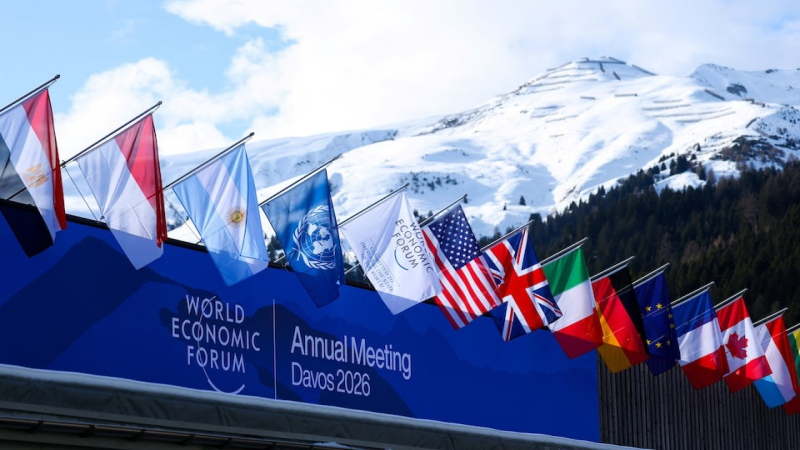
Global business leaders gathered in Davos are turning their attention toward U.S. policy direction as Donald Trump prepares to meet senior executives during the World Economic Forum. The meetings, expected to follow a special address by the U.S. president, have drawn interest from chief executives across finance, technology, crypto, and consulting, reflecting the central role of U.S. policy in shaping global investment decisions. The presence of the U.S. delegation has increasingly shaped the tone of the forum, with discussions extending beyond growth and innovation toward trade policy, national security, and geopolitical alignment. For many corporate leaders, the Davos meetings offer a rare opportunity to gauge Washington’s priorities directly at a time when policy signals are driving volatility across currencies, equities, and capital flows.
The agenda unfolding around the forum has been influenced by recent U.S. policy moves and rhetoric, particularly those tied to trade and strategic interests. Treasury Secretary Scott Bessent has urged European governments against retaliatory measures in ongoing disputes, reinforcing the administration’s view that negotiations should proceed without escalation. These messages have resonated through Davos corridors as executives assess the potential impact on supply chains, cross-border investment, and market access. At the same time, other global powers are using the forum to project their own policy narratives. China’s delegation, led by senior leadership, is engaging directly with international executives, underscoring how Davos has become a venue for competing economic visions rather than a neutral discussion of globalization. The result is a forum increasingly defined by policy positioning as much as by corporate strategy.
For markets, the focus on U.S. leadership and policy intent has reinforced Davos as a barometer of global confidence rather than a purely symbolic gathering. Investors are closely watching how corporate leaders respond to shifting signals on tariffs, regulation, and geopolitical alignment, particularly as asset prices remain sensitive to policy-driven risk. The convergence of political authority and corporate influence at the forum highlights how economic outcomes are being shaped by government decisions as much as by private sector execution. As global growth faces uneven momentum and confidence remains fragile, clarity from U.S. policymakers carries outsized weight for currencies, capital flows, and risk appetite. The Davos meetings, therefore, serve not just as a networking event, but as a real-time stress test for global economic coordination in an environment where policy uncertainty has become a defining feature of the investment landscape.