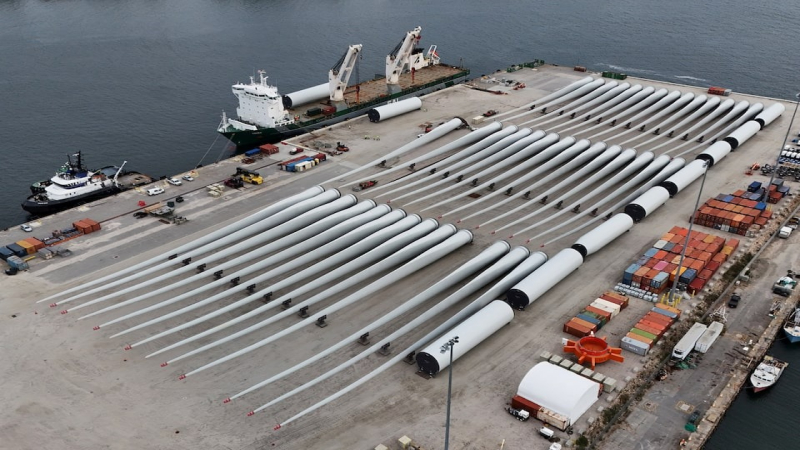
The United States government has suspended construction activity on several large offshore wind projects along the East Coast, citing national security concerns that have sent shockwaves through energy markets and state governments. The decision affects projects already under development and represents a significant escalation in scrutiny of offshore renewable infrastructure. Officials said the pause would allow federal agencies to assess whether turbine structures and rotating blades could interfere with radar systems used to monitor air and maritime threats. The announcement immediately weighed on investor confidence, triggering sharp declines in shares of companies exposed to U.S. offshore wind development. For an industry already grappling with rising costs, regulatory delays, and political uncertainty, the move adds another layer of risk at a critical stage of project execution.
According to government statements, the concern centers on the physical characteristics of offshore wind installations, including large reflective towers and moving blades, which may complicate the detection of low altitude objects. Federal authorities indicated that the suspension is intended to create space for mitigation discussions with developers and state partners rather than permanently cancel projects. However, the lack of a defined timeline has raised fears of prolonged disruption. Offshore wind developers have argued that similar concerns were reviewed and cleared during earlier permitting stages, leaving industry participants frustrated by what they see as shifting standards. The decision underscores how infrastructure linked to energy transition goals can become entangled in broader security and defense debates, especially when projects sit near sensitive coastal zones.
State officials reacted sharply, warning that the pause threatens jobs, investment, and long term energy planning. Several states hosting the affected projects have invested heavily in offshore wind as part of strategies to diversify power supply and reduce emissions. Energy companies also cautioned that halting construction could undermine grid reliability, particularly in regions expecting offshore wind to support growing electricity demand from data centers and industrial users. Developers highlighted the financial strain of stopping and restarting complex marine construction operations, noting that uncertainty increases costs even if projects eventually resume. The episode highlights tensions between federal oversight and state level energy policy, with implications for how future large scale infrastructure projects are evaluated and approved.
The suspension also reflects a broader policy shift that favors traditional energy sources over renewables, adding to the challenges facing offshore wind in the United States. Developers have already faced rising financing costs, supply chain constraints, and political resistance that has made project economics more fragile. Investors now must reassess regulatory risk as a core factor shaping the outlook for clean energy infrastructure. While officials framed the move as a security review rather than an ideological stance, markets responded by repricing exposure to offshore wind. The decision raises questions about the durability of long term energy transition plans when national security considerations are elevated, potentially reshaping investment flows across the power sector.