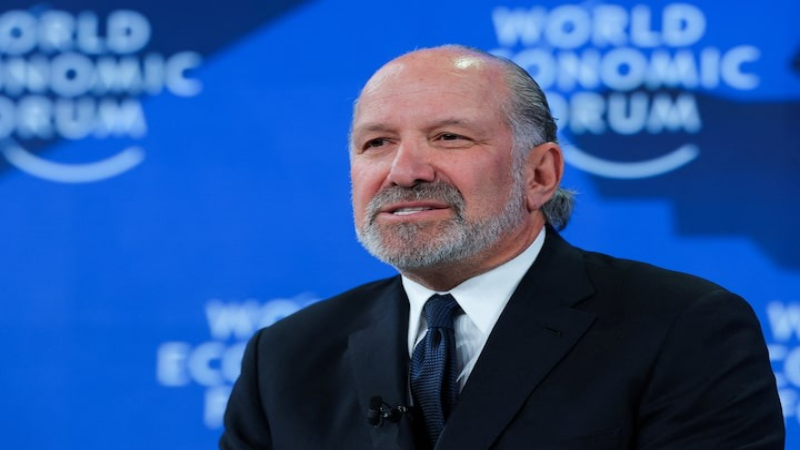
U.S. growth expectations moved sharply into focus at the World Economic Forum in Davos as Howard Lutnick projected first-quarter economic expansion above 5%, framing current interest rate levels as the primary constraint on stronger momentum. Speaking during a panel discussion, Lutnick argued that borrowing costs remain too restrictive for an economy of the United States’ scale, suggesting output could accelerate further if monetary conditions eased. His comments highlighted a growing divergence between political optimism and institutional forecasts at a time when markets remain sensitive to signals on growth sustainability. The remarks come as investors assess whether recent resilience in consumption, investment, and labor markets can translate into sustained above trend growth without reigniting inflationary pressures or destabilizing financial conditions.
Lutnick’s outlook contrasted with more cautious projections from other policymakers and international institutions. While acknowledging that his forecast reflected personal assessment rather than official guidance, the Commerce Secretary positioned domestic economic momentum as strong enough to absorb lower rates without compromising stability. In contrast, the International Monetary Fund continues to project materially slower growth for the United States this year, citing structural constraints and the lagged effects of prior tightening. The difference in views underscores an unresolved tension between policy ambition and macroeconomic reality, particularly as markets weigh the timing and scale of potential rate adjustments. For investors, such divergences complicate expectations around yield trajectories, dollar performance, and capital flows as global portfolios recalibrate around U.S. economic leadership.
Trade policy risks added another layer of uncertainty to the outlook. Lutnick warned the European Union against retaliatory measures in response to threatened U.S. tariffs linked to geopolitical disputes, suggesting escalation would revive tit-for-tat trade dynamics. While he expressed confidence that negotiations would ultimately lead to a pragmatic resolution, the comments reinforced concerns that trade tensions could reemerge as a drag on global growth. The prospect of renewed tariffs carries implications for inflation, supply chains, and transatlantic investment flows, particularly if policy uncertainty persists. Against this backdrop, markets are forced to balance optimism around U.S. growth with caution over external risks that could undermine confidence. As Davos discussions unfold, the contrast between strong domestic projections and fragile global conditions remains a central theme shaping expectations for the dollar, rates, and broader financial stability.