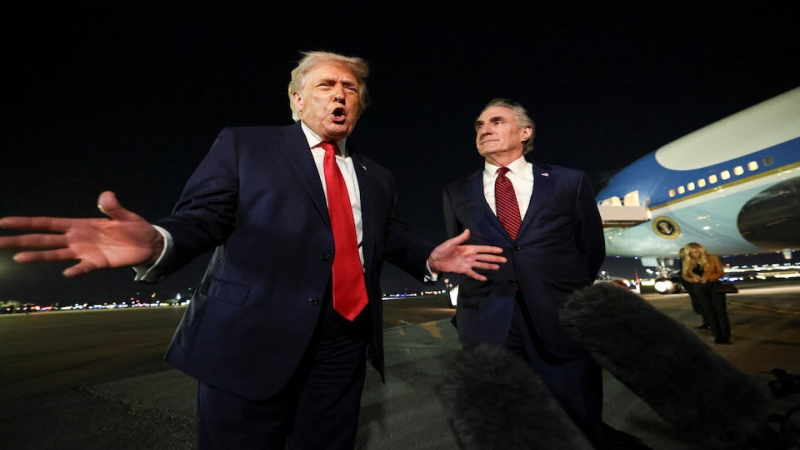
Global political tensions sharpened after Donald Trump reiterated that the United States would not retreat from its objective of asserting control over Greenland, a stance that has unsettled allies and rattled financial markets. Speaking amid the World Economic Forum in Davos, Trump dismissed concerns raised by European leaders and declined to rule out the use of force, framing Greenland as a strategic imperative tied to national and global security. The rhetoric has strained relations within NATO and revived fears of renewed trade conflict between the United States and Europe. Markets responded swiftly, with equities sliding, safe-haven demand rising, and investors reassessing geopolitical risk premiums across assets. The episode underscores how political signaling, even absent immediate policy action, can destabilize sentiment when it challenges long-standing alliances and assumptions underpinning global security and trade frameworks.
European leaders pushed back strongly, warning against coercion and emphasizing sovereignty and collective security. Denmark reaffirmed its position that Greenland is not for sale, while France and other EU members framed the dispute as a test of Europe’s strategic independence. Discussions in Davos highlighted growing concern that escalating rhetoric could translate into economic consequences through tariffs or retaliatory measures. The European Union has signaled that trade tools remain available should pressure intensify, adding uncertainty for cross-border commerce and investment. At the same time, Russia publicly questioned Danish sovereignty over Greenland, adding a further geopolitical dimension to an already volatile situation. These developments have complicated Europe’s policy outlook, forcing leaders to balance deterrence, diplomacy, and economic stability as they confront a more unpredictable transatlantic relationship.
U.S. Treasury Secretary Scott Bessent sought to calm markets, characterizing the reaction as excessive and expressing confidence that negotiations would ultimately prevent escalation. Despite these reassurances, investors appeared unconvinced in the short term, with renewed discussion of capital rotation away from U.S. assets and heightened volatility across markets. The standoff arrives at a sensitive moment for the global economy, already navigating high debt levels, shifting trade policies, and fragile confidence. As leaders continue talks in Davos, the Greenland dispute has become a symbol of broader geopolitical fragmentation, reminding markets that political risk can quickly reprice financial conditions when diplomacy gives way to confrontation.