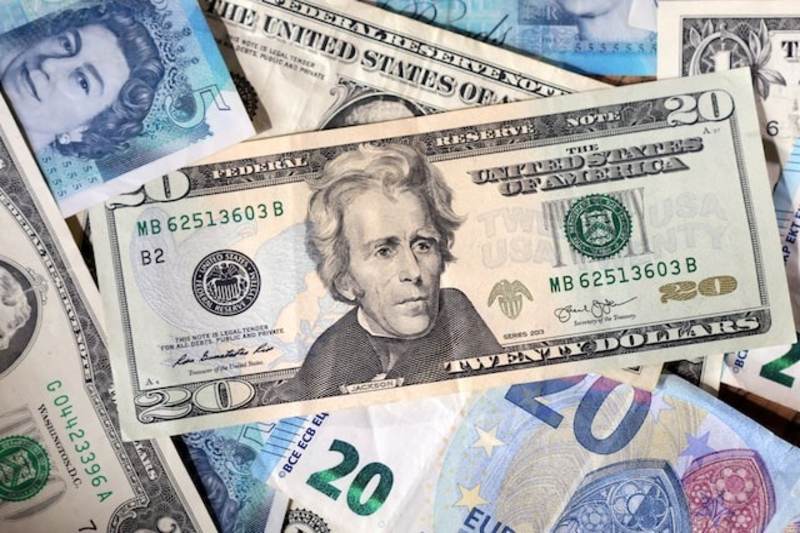
International demand for the United States dollar has surged in global money markets as investors respond to heightened financial volatility and geopolitical tensions. Recent movements in currency derivatives show that foreign investors are increasingly seeking access to dollar liquidity, pushing one key measure of dollar funding demand to its strongest level since April 2025. The shift reflects growing caution across financial markets as investors move capital toward assets perceived as stable during periods of global uncertainty. Analysts say the trend highlights the enduring role of the dollar as the central currency of global finance, particularly during episodes of geopolitical stress and market instability.
A widely watched indicator of dollar demand is the three month euro dollar cross currency basis swap, a derivative used by financial institutions to obtain dollars using euros as collateral. When this measure declines, it signals stronger demand for dollars relative to other currencies. Recent trading data showed the indicator dropping sharply, indicating that investors were willing to pay a premium to access dollar funding. Such movements often occur during periods of market turbulence when institutions and global investors prioritize liquidity and security, particularly in the world’s largest reserve currency.
The surge in dollar demand has coincided with increased volatility in global markets following the escalation of tensions in the Middle East. The conflict has triggered sharp swings in energy prices and increased uncertainty across financial markets, prompting investors to shift capital toward traditional safe haven assets. Currency markets have reacted more cautiously than other asset classes so far, with volatility remaining relatively contained compared with the dramatic movements seen in commodities such as oil and natural gas. However the growing demand for dollar funding suggests underlying stress in parts of the global financial system.
The euro has weakened modestly against the dollar during this period, reflecting the broader shift toward the U.S. currency as investors reassess risk exposure. Since the escalation of geopolitical tensions in late February, the euro has declined against the dollar as financial markets reacted to rising energy prices and concerns about supply disruptions. Europe’s heavy reliance on imported energy has historically made the region particularly sensitive to energy market volatility, which can influence economic expectations and currency performance during periods of geopolitical instability.
Financial analysts note that demand for dollar liquidity often increases when investors anticipate tighter financial conditions or potential market disruptions. Global banks, investment funds and multinational companies frequently rely on dollar funding to support international transactions and investment strategies. During periods of market stress, institutions may increase their demand for dollars to ensure they can meet funding obligations and maintain financial stability. This dynamic reinforces the central role of the U.S. dollar in global financial markets and highlights how quickly liquidity conditions can shift during periods of uncertainty.
The recent surge in dollar demand has also drawn attention from policymakers and central banks monitoring global financial stability. During previous episodes of financial stress, central banks have occasionally coordinated to provide additional dollar liquidity through swap lines and other funding mechanisms. Such measures are designed to prevent shortages of dollar funding from destabilizing financial markets or restricting international trade flows. While current conditions have not yet reached crisis levels, the latest developments in money markets suggest investors are becoming increasingly cautious as geopolitical risks continue to evolve.
Market participants will continue watching currency funding indicators closely in the coming days as geopolitical developments and energy price volatility influence global capital flows. With financial markets reacting rapidly to new information, shifts in dollar demand can provide an early signal of changing risk sentiment across the global economy. The current environment underscores how geopolitical tensions, commodity price movements and financial market liquidity remain deeply interconnected within the modern global financial system.