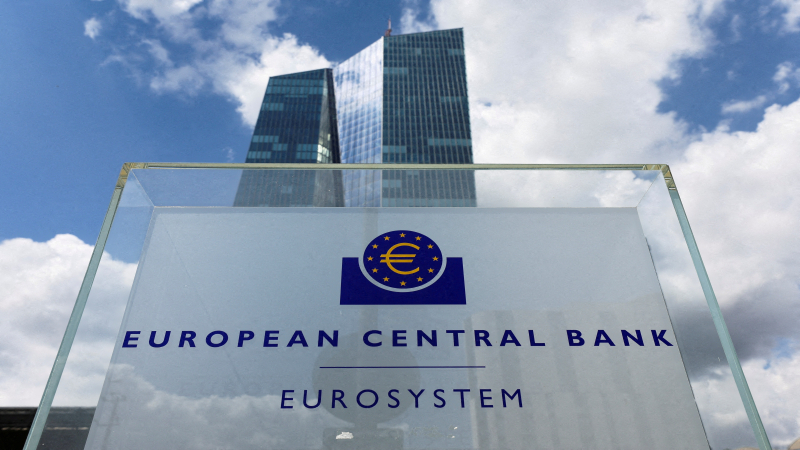
The euro continues to weaken against major global currencies as sluggish growth and uneven inflation keep the eurozone under strain. The European Central Bank (ECB) now faces a difficult balancing act tightening just enough to contain prices while avoiding policies that could deepen stagnation. With business activity lagging and energy costs still high, the region’s economic outlook remains fragile and uncertain.
The currency’s persistent softness mirrors a combination of internal weakness and external strength. The U.S. dollar’s resilience, powered by higher yields and stronger economic data, has pushed investors toward dollar assets. Meanwhile, Europe’s domestic indicators suggest slowing consumer demand, fragile investment, and limited fiscal space for stimulus. As policymakers prepare for upcoming ECB meetings, the question is whether easing rates could revive confidence or risk fueling renewed inflation.
Growth Remains Fragile Across the Eurozone
Recent data underline how the eurozone economy is struggling to regain momentum. The manufacturing and services PMIs continue to hover near contraction territory, signaling that activity is barely expanding. Germany, the region’s largest economy, remains constrained by weak exports and energy costs, while France is coping with slower investment and subdued consumer spending.
Southern Europe shows modest resilience thanks to tourism and construction, but these gains are insufficient to offset broader weakness. The slowdown in industrial demand has reduced employment opportunities, and businesses are cautious about expanding capacity. Economists warn that unless demand recovers soon, the region could enter a prolonged low-growth phase, leaving the euro under pressure.
Euro Faces Headwinds from Monetary Divergence
The euro’s decline is also shaped by diverging central-bank strategies. The Federal Reserve’s higher-for-longer stance continues to attract global capital toward U.S. assets, strengthening the dollar. In contrast, the ECB’s room for further tightening is limited by weak growth and political sensitivities over borrowing costs in southern Europe.
This divergence in yield curves has widened the interest-rate gap between U.S. Treasuries and European bonds, reducing the euro’s appeal to investors. A weaker currency helps exporters by making eurozone goods cheaper abroad, but it also makes imported commodities costlier, adding inflationary risk. For policymakers, it is a difficult trade-off: allowing the euro to fall supports output but risks destabilizing prices again.
Market expectations now suggest that any ECB rate cuts will be cautious and gradual. Officials have repeatedly stressed data dependence, focusing on wage trends and service-sector inflation. While the ECB aims to anchor inflation near 2 percent, policymakers are aware that premature easing could reignite price pressures.
ECB’s Tightrope Walk on Inflation and Growth
The ECB’s leadership faces growing scrutiny over how to balance competing mandates. Inflation has slowed from its 2022 peak but remains uneven across member states. Some economies, such as Spain and Portugal, have brought prices under control, while others continue to experience elevated wage-driven inflation. The lack of uniformity complicates policymaking for the single currency area.
ECB President Christine Lagarde has acknowledged the challenge of maintaining credibility while responding flexibly to data. Markets now expect that the ECB will focus on forward guidance, signaling caution without ruling out future easing. This delicate messaging aims to reassure investors that monetary stability remains the priority even amid economic softness.
Global Implications of Euro Weakness
The euro’s decline affects not only the European economy but also global trade dynamics. A weaker euro typically boosts European export competitiveness but can also distort capital flows by strengthening the dollar’s dominance. For emerging markets that borrow in dollars, this means higher debt-servicing costs and potential currency depreciation.
Global investors are treating the euro’s slide as a gauge of international confidence in Europe’s recovery. Sustained weakness could accelerate portfolio outflows from the region’s bond markets, particularly if growth data continue to disappoint. However, some analysts note that once the ECB signals rate stability and inflation cools further, the euro could regain traction later in 2026.
Conclusion
The euro’s current weakness highlights the eurozone’s ongoing struggle to balance inflation control with economic revival. The ECB’s cautious stance reflects the difficult reality of managing a diverse and uneven monetary union. Whether the currency stabilizes or continues to fall will depend on how effectively the bank restores confidence without sacrificing growth. For now, the euro remains caught between global monetary forces and the region’s slow-moving recovery.