Emerging market equities are delivering one of their strongest starts to a year in decades, driven by artificial intelligence momentum, structural reforms and a sharp rotation of global capital away from the United States. The scale and speed of the rally, however, are raising questions about sustainability.
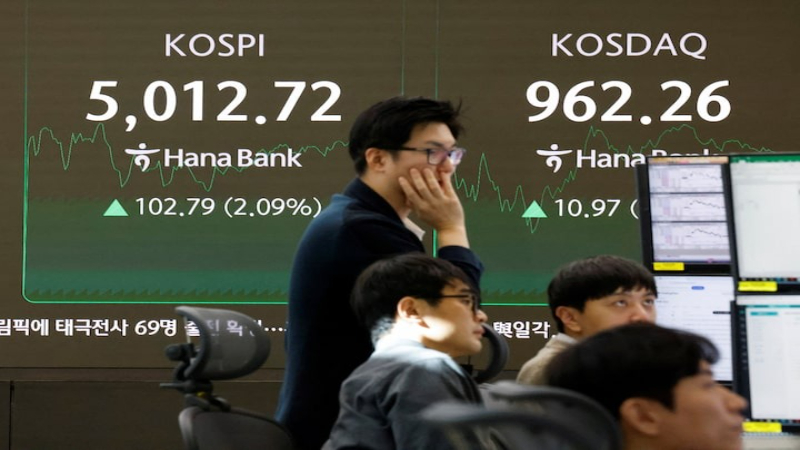
South Korea has become the standout performer. The benchmark KOSPI index has surged roughly 50 percent in the first two months of 2026 and has doubled over the past six months. From the lows recorded during last year’s tariff related volatility, the index has climbed nearly 175 percent. Shares of Samsung Electronics, the world’s largest memory chipmaker, have nearly doubled this year alone, reflecting strong demand tied to AI infrastructure and semiconductor cycles.
Taiwan has also posted powerful gains. The island’s equity market is up nearly 25 percent this year, supported by Taiwan Semiconductor Manufacturing’s central role in global AI supply chains serving companies such as Nvidia and Apple. Taiwan’s statistics office recently lifted its 2026 GDP growth forecast to 7.7 percent, more than doubling its earlier projection, underscoring the economic impact of technology exports.
Broader emerging market benchmarks confirm the momentum. MSCI’s emerging market index and Asia ex Japan index have both risen around 15 percent this year, while Brazil’s main equity gauge has advanced close to 20 percent. Investors appear increasingly willing to rotate capital toward markets perceived as offering stronger growth prospects and more attractive valuations.
Fund flow data reinforces this shift. Recent global fund manager surveys show investors are now the most overweight emerging market equities in five years. In some allocations, emerging markets represent the largest overweight position across all asset classes, surpassing US equities for the first time in years.
Valuation comparisons continue to support the narrative. Despite the rally, emerging market stocks still trade at a discount to US benchmarks on forward earnings multiples. The valuation premium long enjoyed by the S and P 500 has narrowed slightly but remains elevated by historical standards. For global portfolio managers, the relative gap leaves room for continued rebalancing.
Currency dynamics have also contributed. The Korean won has strengthened to its firmest level in several months, reflecting capital inflows and improved investor confidence. A softer US dollar environment typically provides additional support to emerging market assets by easing external financing conditions.
Still, the pace of gains has sparked debate. Financial conditions in South Korea have loosened significantly, and rapid price appreciation raises the risk of overheating. While forward earnings growth expectations remain strong, markets often struggle to maintain parabolic advances without periods of consolidation.
For now, strong corporate earnings, resilient global growth and ongoing AI investment provide a powerful backdrop. Whether the rally extends or moderates will likely depend on sustained earnings delivery, stable US interest rates and continued global capital rotation trends.