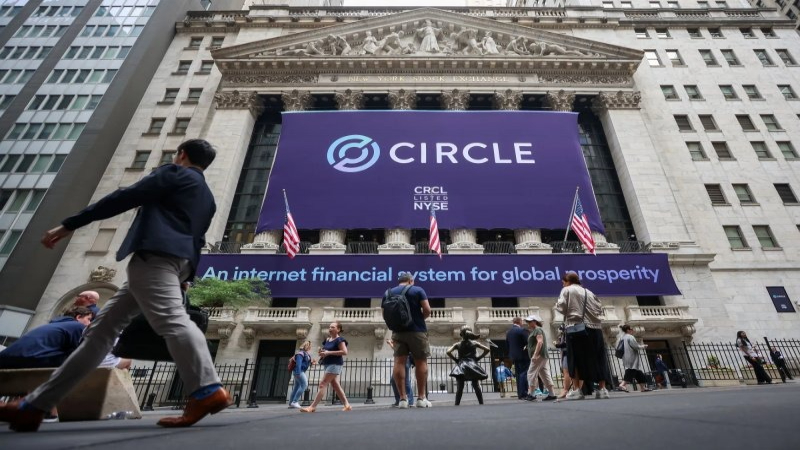
Circle Internet Group delivered stronger than expected fourth quarter results, driven by a sharp rise in circulation of its USDC stablecoin and higher income from reserve assets. The company reported total revenue of 770 million dollars, up 77 percent from a year earlier and above analyst expectations of 739 million dollars, sending its shares up nearly 30 percent in afternoon trading.
The performance was fueled primarily by growth in USDC, Circle’s dollar pegged stablecoin, which saw circulation increase 72 percent year over year to 75.3 billion dollars during the quarter. As USDC supply expanded, revenue generated from reserves climbed to 733 million dollars. Circle earns income by investing the cash backing its issued tokens into deposits and short dated US Treasury securities, capturing the yield on those assets.
The results highlight the continued expansion of regulated stablecoins within the broader digital asset ecosystem. USDC adoption has accelerated amid a more defined regulatory environment in the United States, particularly following the passage of federal legislation that established a framework for dollar backed stablecoins. Clearer oversight has encouraged greater participation from institutions seeking compliant digital dollar solutions for payments and settlement.
Circle’s revenue model remains sensitive to Federal Reserve policy. Higher interest rates have supported reserve income over the past two years, but they have also constrained liquidity and risk appetite across financial markets. Company executives indicated that further rate cuts in 2026 could stimulate broader economic activity and increase transaction velocity, potentially driving additional growth in stablecoin circulation even if yields moderate.
The firm has also taken steps to deepen its integration with the traditional financial system. In December, Circle received conditional approval to establish a national trust bank charter, a move that could strengthen its ability to hold reserves directly and expand regulated services. Partnerships have further broadened its reach, including collaboration with Visa to enable US institutions to settle transactions using USDC.
Market participants are increasingly viewing stablecoins as core infrastructure for digital finance rather than speculative instruments. Rising adoption across exchanges, payment platforms and decentralized finance applications has reinforced demand for dollar linked tokens that provide on chain liquidity while maintaining price stability.
The fourth quarter surge in USDC circulation comes at a time when investors are reassessing growth prospects across the technology and crypto sectors. While volatility persists in digital asset prices, stablecoins have continued to expand as a transactional layer within both centralized and decentralized markets.
Circle’s results underscore how stablecoin issuers can benefit from both regulatory clarity and growing institutional use cases. As digital payments evolve and tokenized financial assets gain traction, reserve backed stablecoins are emerging as a significant revenue generating segment within the broader crypto and financial technology landscape.