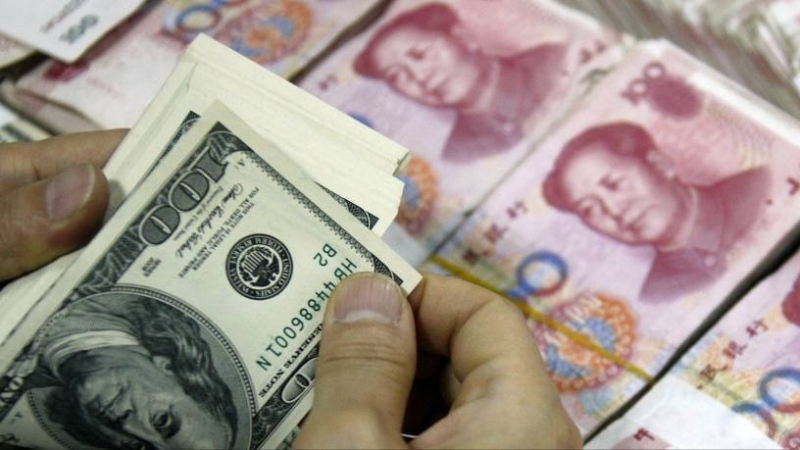
China’s currency, the renminbi (RMB), continues to gain traction in international trade as Beijing promotes wider global use of its financial infrastructure. Yet despite steady progress, the U.S. dollar remains the world’s central currency for payments, investment, and reserves.
The shift toward RMB use underscores a gradual transformation rather than a revolution. While more trade settlements and bilateral deals now include the yuan, structural factors such as convertibility limits, liquidity depth, and market trust still keep the dollar firmly in control.
Rising Role of the RMB in Global Trade
The expansion of the RMB in trade settlements reflects China’s growing role in global commerce. As the world’s largest exporter and a key energy importer, China has encouraged partners to invoice and settle transactions in its currency. Countries in Asia, Africa, and the Middle East are increasingly using the yuan for trade in raw materials, electronics, and energy products.
Financial data show that cross-border RMB settlements have risen sharply over the past year. The currency’s share in global trade financing has also edged higher as more companies open RMB accounts to manage payments through China’s Cross-Border Interbank Payment System (CIPS). The rise is particularly visible in energy trade, where several exporters have begun accepting yuan for oil and gas shipments.
For China, the push serves dual purposes. It strengthens economic influence while reducing vulnerability to dollar fluctuations and sanctions risk. The growing use of the RMB in trade settlements is also a step toward Beijing’s longer-term goal of establishing a parallel financial ecosystem less dependent on Western banking networks.
Dollar’s Network Advantage Remains Unmatched
Despite China’s progress, the dollar continues to dominate global finance. Nearly 85 percent of foreign-exchange transactions still involve the greenback, and over half of all international reserves are held in U.S. assets. Global banks and corporations rely on the dollar’s unmatched liquidity, deep capital markets, and institutional transparency.
Even countries that trade extensively with China often continue to clear transactions through dollar channels. The global payment infrastructure, including the SWIFT network, remains overwhelmingly dollar-centric. That dominance gives the U.S. financial system a structural advantage that is difficult to dislodge.
Another key factor is trust. Investors and central banks view U.S. markets as transparent and legally predictable, qualities that the RMB system has yet to fully replicate. China’s capital controls, limited convertibility, and regulatory opacity still constrain broader acceptance. As a result, most global reserve managers continue to treat the yuan as a supplementary currency rather than a substitute.
Strategic Efforts to Internationalize the Yuan
China’s strategy to internationalize the RMB has evolved through targeted partnerships and gradual liberalization. Bilateral swap lines between the People’s Bank of China and foreign central banks have expanded, creating local liquidity buffers for trade settlements. More offshore hubs, such as those in Singapore, Hong Kong, and London, are providing RMB clearing and deposit services to facilitate transactions.
Energy trade has been a focus area. Recent deals with major oil exporters to settle contracts in yuan highlight China’s growing leverage in commodities pricing. The use of CIPS also reflects an effort to build resilience against potential disruptions to the SWIFT system.
Nevertheless, widespread adoption depends on trust and openness. Investors seek not only stability but also freedom of capital movement. For the RMB to reach its full potential, China would need to further liberalize its financial markets, reduce regulatory uncertainty, and allow greater transparency in exchange-rate management.
Implications for Global Finance and Policy
The growing role of the RMB has important implications for global monetary policy. For emerging markets that trade heavily with China, using the yuan in settlements can reduce exchange-rate risk and transaction costs. It also provides diversification benefits when managing foreign-exchange reserves.
However, greater RMB use does not necessarily weaken the dollar immediately. Instead, it points to a slow diversification process where regional trade patterns begin to reflect local currency use while global reserves remain anchored in U.S. assets. The world is moving toward a more multipolar currency framework, but that evolution will take years, not months.
From a policy standpoint, the dollar’s dominance remains both an asset and a responsibility for the United States. High demand for dollar assets keeps U.S. borrowing costs lower, but it also exposes global markets to shifts in Federal Reserve policy. Conversely, China’s rise in trade finance gives developing economies an alternative mechanism for liquidity, even if it remains small compared to established dollar networks.
Conclusion
The rise of the RMB in trade settlements marks an important shift in the architecture of global finance, but it does not yet signal a challenge to the dollar’s supremacy. The U.S. currency continues to define liquidity, reserve safety, and financial trust worldwide. As China expands its economic reach and modernizes its financial system, the yuan’s role will continue to grow gradually. For now, the world remains anchored to the dollar, with the RMB serving as a complementary, rather than competitive, force in global payments.