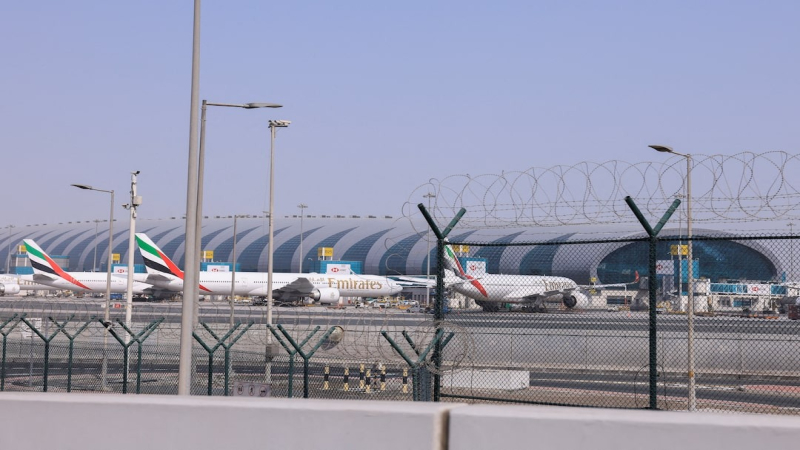
Escalating tensions in the Middle East have placed Dubai’s aviation hub under intense scrutiny, highlighting how deeply global air travel depends on a small cluster of Gulf based transit centers. As airspace closures and security concerns ripple through the region, Dubai International Airport, the world’s busiest airport for international passengers, faces one of its most significant operational tests in years.
Founded in 1985 during the Iran Iraq war, Emirates began with just two leased aircraft and two routes. Over four decades, Dubai transformed itself into a central aviation crossroads linking more than 110 countries and handling roughly 454000 flights annually. Its geographic positioning allows one third of the global population to be reached within four hours and two thirds within eight hours, giving the hub exceptional aggregation power for both transit and destination traffic.
Recent military exchanges involving the United States, Israel and Iran have brought instability closer to the Gulf’s core transport infrastructure. Reports of strikes and missile activity have forced temporary airspace shutdowns across Dubai, Doha and Abu Dhabi, disrupting flight schedules and stranding tens of thousands of passengers. The shutdown of all three major Gulf hubs simultaneously is unprecedented in modern aviation.
Dubai Airports leadership has emphasized the resilience of its diversified traffic mix, which balances inbound tourism with transit flows. However, restoring normal operations involves a complex logistical challenge. Airlines must reroute aircraft, reposition crews and manage displaced passengers while minimizing longer term damage to confidence in the hub’s reliability.
Most aviation analysts believe that, unless the conflict evolves into a prolonged regional war, the Gulf trio will likely regain momentum due to the scale and connectivity of their networks. The hubs have previously demonstrated rapid recovery following regional instability and even the severe demand shock of the pandemic era. Yet the current environment differs in a crucial way. This time, it is demand rather than supply that could face sustained pressure.
Travelers may increasingly opt for direct long haul routes that bypass Middle Eastern stopovers. Advances in aircraft technology are enabling airlines to operate ultra long range flights that connect cities such as Sydney and London nonstop, reducing reliance on traditional transit hubs. Airbus has recently expanded production of extended range A350 aircraft designed to support these routes, signaling structural changes in global aviation patterns.
At the same time, competitive pressures are building. Turkish Airlines, operating from its mega hub in Istanbul outside the immediate conflict zone, is positioned to capture diverted traffic. Saudi Arabia is expanding its aviation ambitions, while Indian and broader Asian carriers are also strengthening their networks.
Shipping disruptions and heightened geopolitical risk have introduced broader economic uncertainty across the region. For Dubai, the question extends beyond transit passengers to destination traffic and long delayed airport expansion plans. Market observers suggest that while traffic volumes are likely to rebound over time, perceptions of stability will influence long term growth.
For Emirates and its affiliate flydubai, market power and network reach may play a decisive role in accelerating recovery. Pricing strategies and schedule flexibility could help rebuild passenger confidence as global aviation adapts to a rapidly shifting geopolitical landscape.