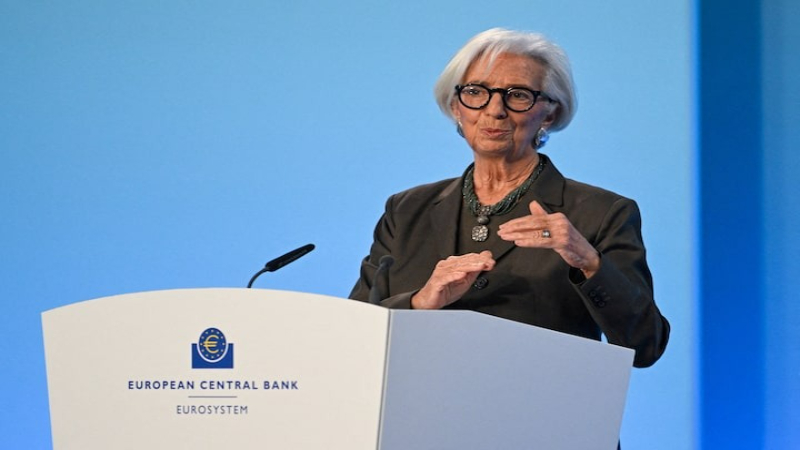
Euro zone inflation is expected to settle back at the European Central Bank’s two percent target after temporarily falling below that level this year, according to comments from ECB President Christine Lagarde that reinforced the central bank’s cautious and flexible policy stance. Speaking to European lawmakers in Strasbourg, Lagarde said the inflation outlook had improved, but warned that risks and uncertainty remain elevated across the euro area economy.
Lagarde told legislators that the ECB’s latest assessment confirms price growth should stabilise at the central bank’s medium term goal. While recent data suggest inflationary pressures have eased faster than expected, she emphasized that policymakers are not declaring victory. Instead, the ECB will continue to rely on incoming economic indicators when deciding how to steer interest rates in the months ahead.
The comments underline the ECB’s commitment to a data driven approach at a time when markets are increasingly focused on the timing and pace of potential rate cuts. Inflation across the euro zone has cooled markedly from the peaks seen in recent years, driven by lower energy prices, easing supply chain disruptions, and tighter financial conditions. However, policymakers remain wary that services inflation and wage growth could still pose challenges to a smooth return to price stability.
Lagarde noted that the current environment is marked by overlapping sources of uncertainty, including geopolitical tensions, shifting global trade dynamics, and uneven economic growth across member states. These factors, she said, make it essential for the ECB to assess conditions meeting by meeting rather than committing to a fixed policy path in advance.
Financial markets have been quick to interpret the ECB’s messaging as a sign that interest rate cuts are approaching, even if officials have stopped short of offering explicit guidance. Investors are weighing Lagarde’s remarks against recent signals from other major central banks, particularly as divergences emerge between the euro zone, the United States, and the United Kingdom on the direction of monetary policy.
The ECB has held borrowing costs steady in recent meetings, arguing that it needs greater confidence that inflation will remain anchored at the two percent target before easing policy. Lagarde’s remarks suggest that while progress has been made, the governing council is still looking for consistent confirmation from data on wages, underlying inflation, and economic activity.
Her appearance before lawmakers also comes at a sensitive time politically, as several euro zone governments face domestic pressure over high living costs and weak growth. While inflation has fallen, households continue to feel the impact of earlier price surges, and businesses remain cautious about investment amid uncertain demand.
By reaffirming the ECB’s inflation objective and its cautious strategy, Lagarde sought to strike a balance between reassurance and restraint. She made clear that the central bank stands ready to adjust policy as conditions evolve, but will not be rushed by short term market expectations.
As the euro zone navigates a fragile recovery, investors and policymakers alike will be watching upcoming inflation and wage data closely. For now, Lagarde’s message was clear. Inflation may be moving back toward target, but the path forward remains complex, requiring patience, vigilance, and flexibility from Europe’s central bankers.