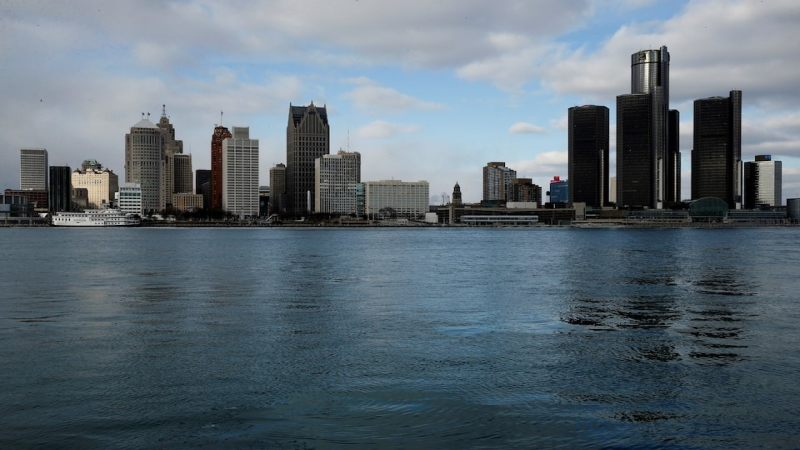
The global business conversation emerging from Davos has increasingly focused on inequality, artificial intelligence, and financial concentration, but voices from America’s industrial heartland argue that this framing misses where real economic value is still created. Business leaders in Detroit say manufacturing, mobility, and physical production remain central to employment, supply chains, and long-term growth, even as markets continue to reward technology-driven valuations. While capital markets often chase digital scale, the industrial economy continues to anchor wages, regional development, and export capacity. Detroit’s resurgence highlights this tension, combining relatively affordable housing with rising prices and uneven prosperity across neighborhoods. The contrast underscores how economic transitions are felt differently on the ground than in financial centers, where global policy discussions are shaped. For Midwest manufacturers and suppliers, the conversation is less about abstract inequality metrics and more about sustaining competitive production ecosystems that can adapt to shifting technologies and capital flows.
Local business leaders point to infrastructure investment and workforce development as rare areas of bipartisan alignment in a deeply polarized national environment. Michigan’s approach to funding post-secondary education pathways, including community college degrees and skilled credentials, is framed as a direct response to talent shortages faced by large employers. The goal is to connect education spending to employability rather than abstract attainment targets. Despite this progress, income inequality remains closely tied to gaps in education and training, reinforcing political and cultural divisions across the state. Corporate leaders warn that without a reliable pipeline of skilled workers, investment decisions may tilt away from legacy manufacturing regions. The concern is not ideological but practical, as companies compete globally for talent while navigating domestic political uncertainty. These dynamics have become more pronounced as economic policy debates increasingly intersect with identity and regional opportunity.
Trade policy has emerged as a particularly sensitive issue for Michigan’s economy, with tariffs and regulatory shifts carrying disproportionate consequences for automotive and mobility sectors. Business groups in the state have taken a more vocal stance than national counterparts, citing risks to manufacturing supply chains and the potential for stranded capital following rapid changes in electric vehicle technology. While some regulatory streamlining has been welcomed, uncertainty around trade rules continues to complicate long-term investment planning. Companies face the challenge of aligning production strategies with policies that can shift sharply across election cycles. For an industry built on multi-year capital commitments, volatility in trade and industrial policy can be as damaging as unfavorable rules themselves. This reality has driven calls for more predictable frameworks that balance competitiveness with domestic manufacturing priorities.
Detroit’s message to global business forums is not rejection but recalibration. Local leaders argue that meaningful dialogue requires engaging universities, labor pipelines, philanthropy, and social services alongside corporate executives. Without this broader participation, economic discussions risk becoming insular and detached from implementation realities. The city’s experience illustrates how industrial regions absorb the downstream effects of global capital decisions, from workforce displacement to housing pressures. As global institutions look beyond traditional conference hubs, Detroit positions itself as a testing ground for reconnecting financial narratives with production-based economies. The underlying argument is straightforward: sustainable growth depends not only on innovation and capital efficiency, but on places where goods are built, skills are formed, and economic resilience is tested daily.