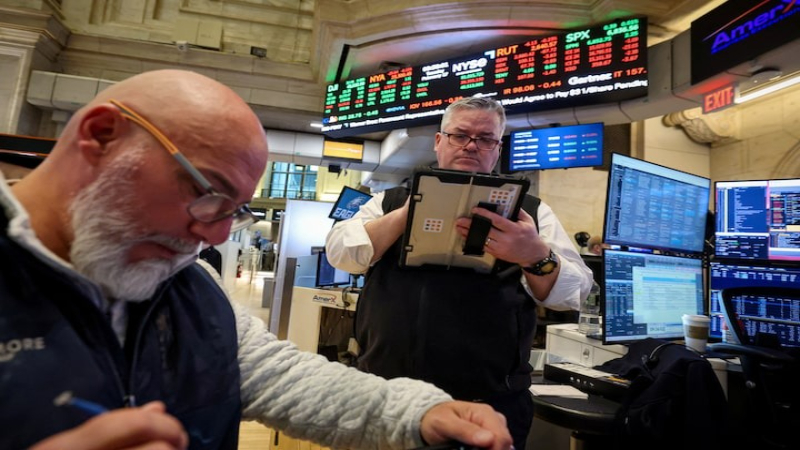
US equities fell sharply on Monday, with losses led by software and financial shares, as renewed uncertainty over trade policy unsettled investors. The Dow Jones Industrial Average dropped about 1.5 percent, the S&P 500 declined roughly 1.1 percent, and the Nasdaq Composite lost around 1.2 percent in broad based selling that reflected weaker risk appetite across sectors.
The pullback followed a Supreme Court ruling that invalidated key elements of President Donald Trump’s tariff framework, a decision that reopened questions about the direction of US trade policy. In response, Trump signaled plans to impose a temporary 15 percent tariff on imports, reviving concerns about unpredictable policy shifts. Investors fear that fresh trade tensions could disrupt supply chains, dampen business investment, and cloud earnings visibility.
Financial stocks were among the worst performers, falling more than 3 percent as lower risk tolerance and potential economic headwinds weighed on sentiment. Software companies also came under pressure, sliding about 4 percent amid continued debate over artificial intelligence driven disruption. Investors have been reassessing valuations in technology names as new AI platforms reshape competitive dynamics and margin expectations.
The selloff extended beyond technology and banks. Airline and travel related shares declined sharply as a powerful winter storm swept across parts of the United States, leading to widespread flight cancellations in the Northeast. Transportation stocks broadly weakened, reflecting concerns over short term operational disruptions and softer travel demand.
In contrast, defensive areas such as consumer staples showed relative resilience. Healthcare stocks also gained ground, supported by company specific developments. Eli Lilly advanced after rival Novo Nordisk reported trial results for its obesity drug CagriSema that underperformed expectations when compared with Lilly’s treatment. The divergence highlighted how sector rotation and stock specific catalysts can offset broader market weakness.
Fourth quarter earnings season is nearing completion, with roughly three quarters of S&P 500 companies that have reported exceeding analyst estimates. Aggregate earnings growth is now projected to approach 14 percent year on year, higher than forecasts at the start of the year. Investors are closely watching upcoming results from major names including Nvidia, Home Depot, Lowe’s, Salesforce, and Universal Health Services for further guidance on corporate momentum.
Market breadth reflected the negative tone, with declining issues outnumbering advancers by more than two to one on both the New York Stock Exchange and the Nasdaq. Gold prices rose more than 2 percent as investors sought safety, underscoring a shift toward defensive positioning.
As volatility resurfaces, traders remain focused on how evolving trade measures, monetary policy expectations, and sector specific disruptions will shape equity valuations in the weeks ahead.