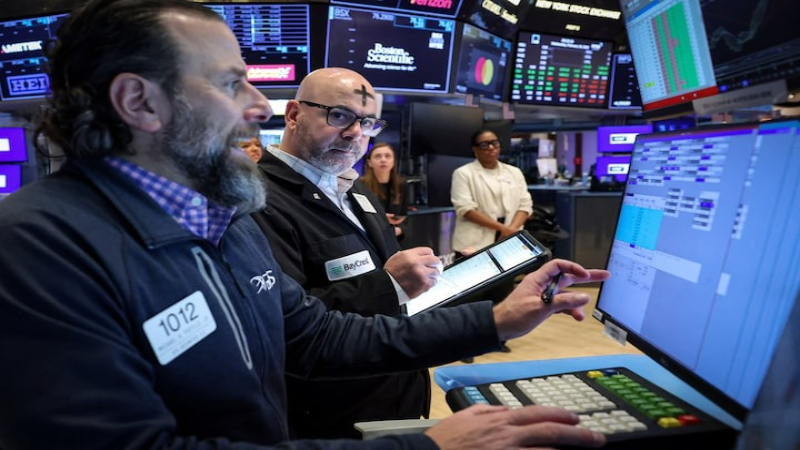
Wall Street ended in negative territory as losses in technology and private equity shares offset strength in selected industrial names, reflecting continued investor caution around valuations and credit risk. Major US indexes slipped modestly, with the Dow Jones Industrial Average falling 0.54 percent, the S&P 500 declining 0.28 percent, and the Nasdaq Composite losing 0.31 percent.
Technology remained a focal point for traders, with Nvidia and other AI linked stocks facing renewed pressure amid concerns that high expectations may be running ahead of earnings visibility. Apple also weighed heavily on the S&P 500, retreating around 1.4 percent and contributing significantly to the broader index decline. Investors have increasingly questioned whether large capital expenditures in artificial intelligence will translate into sustained revenue growth across the sector.
Private equity firms were among the session’s weakest performers after Blue Owl Capital announced it would sell 1.4 billion dollars in assets and freeze redemptions in one of its funds as part of efforts to manage debt and return capital. The move heightened concerns about credit quality and exposure to leveraged investments, particularly in software and technology driven portfolios. Shares of Apollo Global Management, Ares Management, KKR, and Carlyle Group all fell between roughly 2 percent and 5 percent, while Blue Owl dropped even more sharply.
The pullback in financial stocks dragged the S&P 500 financial index lower by nearly 1 percent, reflecting sensitivity to credit conditions and potential stress in alternative asset managers. In contrast, the energy sector gained ground as crude oil prices advanced on geopolitical tensions in the Middle East, lifting the S&P 500 energy index by about 0.6 percent.
Corporate earnings provided a mixed backdrop. Deere surged more than 11 percent after raising its full year profit forecast and reporting stronger than expected quarterly results, offering support to industrial shares. Advertising giant Omnicom rallied strongly after beating revenue estimates, while EPAM Systems tumbled following a cautious outlook that disappointed investors. Carvana also declined after missing profit expectations.
Retail stocks added to market softness, with Walmart easing after unveiling a conservative long term forecast alongside a sizable share buyback plan. The muted outlook signaled that companies remain cautious about consumer demand despite resilience in some economic indicators.
Weekly jobless claims fell more than expected, underscoring continued strength in the labor market. However, the data did little to offset broader unease about equity valuations and potential disruption from rapid advances in artificial intelligence.
In currency markets, the modest equity retreat supported a steady tone in the US dollar as investors balanced risk appetite with ongoing uncertainty around growth and corporate earnings momentum.