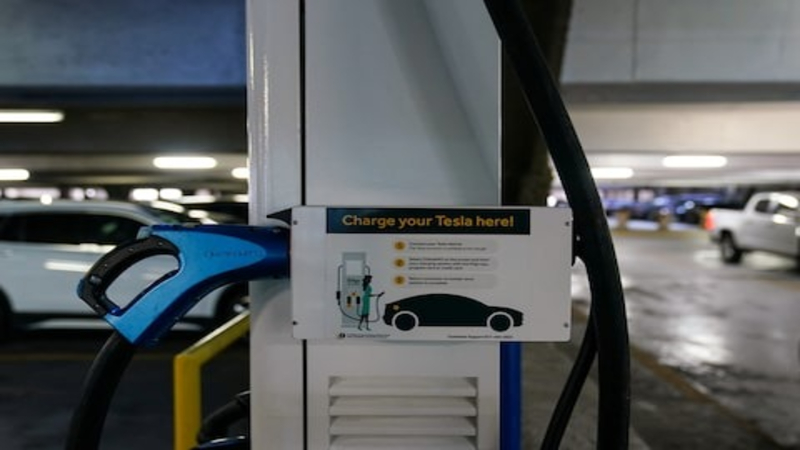
The United States government is moving toward stricter domestic sourcing requirements for electric vehicle charging stations financed with federal funds, signaling a stronger push to expand American manufacturing within the clean transportation sector. The Transportation Department has proposed increasing the required level of American made components in federally funded charging equipment from the current threshold of fifty five percent to as much as one hundred percent.
The proposal applies to the national electric vehicle charging program, which is backed by seven point five billion dollars in federal funding. The program is designed to build out a nationwide network of charging stations to support the growing adoption of electric vehicles. Under existing rules, some flexibility was granted to allow the use of foreign made components due to limited domestic supply and manufacturing capacity. The new proposal would significantly narrow or eliminate those waivers over time.
Transportation officials argue that strengthening Buy America standards will help accelerate domestic production of charging equipment while reducing reliance on overseas suppliers. According to the department, higher domestic content requirements are expected to support job creation, improve supply chain resilience, and boost competitiveness among US based manufacturers. Officials also highlighted national security considerations, noting that critical infrastructure tied to transportation and energy should rely less on foreign sourced technology.
If finalized, the stricter rules could create challenges for companies involved in deploying charging stations. Many charging systems currently rely on imported components such as power electronics, connectors, and certain software integrated hardware elements. Meeting a one hundred percent American content threshold would require companies to either reconfigure supply chains or delay projects until compliant equipment becomes available.
Industry participants have previously raised concerns that overly rigid domestic sourcing rules could slow the rollout of charging infrastructure, especially in the short term. While the administration has emphasized long term benefits, companies and state agencies responsible for installation may face higher costs and logistical hurdles during the transition. Some market participants warn that supply bottlenecks could emerge if domestic manufacturing does not scale up quickly enough to meet demand.
Major automakers and charging network operators are closely watching the proposal, as it could influence deployment timelines and investment decisions. The policy shift may also encourage new investment in US based factories producing charging equipment, cables, and related hardware. Supporters of the proposal argue that such investment could help establish a stronger domestic ecosystem for electric mobility technologies.
The proposal reflects a broader effort by the federal government to reinforce domestic manufacturing across strategic industries, including clean energy and transportation. Buy America policies have become a central feature of infrastructure spending, with officials aiming to ensure that public funds directly support American workers and businesses.
The Transportation Department has opened the proposal for review, and feedback from industry stakeholders and state governments is expected to play a role in shaping the final requirements. Any changes could have wide ranging implications for the pace and cost of electric vehicle infrastructure expansion across the United States.