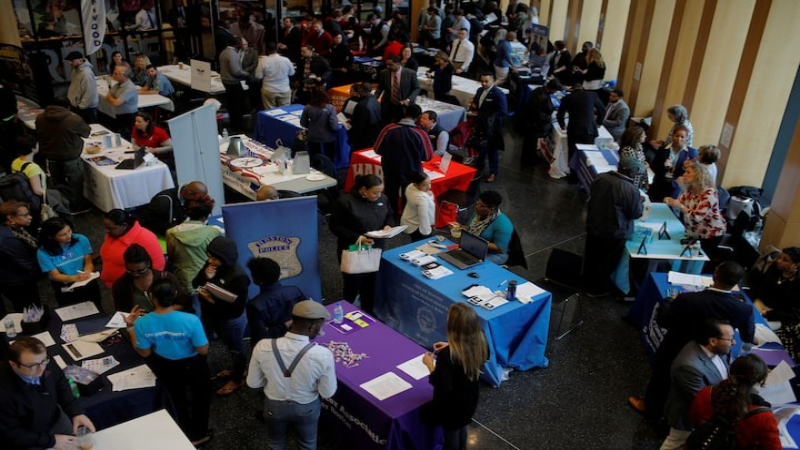
New applications for US unemployment benefits rose slightly last week, reinforcing signs that the labor market remains stable but subdued as the economy enters 2026. Weekly filings increased only marginally and remained well below levels typically associated with job losses accelerating, suggesting employers are largely holding onto workers even as hiring momentum stays limited. Seasonal adjustment challenges around the turn of the year have added noise to recent data, but underlying conditions point to what economists describe as a low hiring, low firing environment. Job creation has slowed compared with earlier post pandemic years, yet layoffs have not meaningfully picked up. This balance has helped keep labor market conditions steady, even as businesses reassess staffing needs amid higher costs, policy uncertainty, and increased investment in automation and artificial intelligence.
Data from the US Labor Department showed initial claims rose by just one thousand to two hundred thousand, undershooting market expectations and remaining near multi decade lows. Continuing claims, which track those already receiving benefits, declined further, signaling that some displaced workers are exiting the rolls even if reemployment is taking longer. Economists note that while layoffs are limited, job seekers face fewer openings, contributing to longer job searches. Recent payroll reports have reflected this dynamic, with monthly job gains slowing to modest levels. Revisions expected in upcoming employment data may further highlight a cooling trend that began last year. Businesses appear cautious, balancing steady demand with uncertainty over trade policy, immigration rules, and productivity shifts tied to new technologies.
Alongside labor data, updated economic figures painted a picture of strong output growth paired with uneven distribution of gains. Gross domestic product growth for the third quarter was revised slightly higher to an annualized pace exceeding four percent, driven by consumer spending, business investment, and a narrower trade gap. Consumption remained the backbone of expansion, though economists noted a divergence between higher income households and the broader population. Investment linked to artificial intelligence continued to support growth, while trade flows also contributed positively. Despite robust output, hiring has not accelerated in tandem, reinforcing concerns that economic gains are not translating evenly into job creation. This pattern has fueled debate over whether current growth can deliver broader labor market benefits in the months ahead.
Inflation pressures also remained elevated during the same period, complicating the outlook for monetary policy. Price measures tied to domestic purchases and core consumer spending rose at rates above the central bank’s target, reflecting lingering cost pressures from tariffs, housing, and services. These dynamics are being closely watched by the Federal Reserve, which is widely expected to keep interest rates unchanged at its next meeting. Financial markets reacted cautiously, with equities higher, bond yields softer, and the dollar easing. The combination of steady jobless claims, strong output growth, and persistent inflation underscores a complex economic landscape where resilience coexists with structural challenges, leaving policymakers and investors focused on whether growth can broaden without reigniting price pressures.