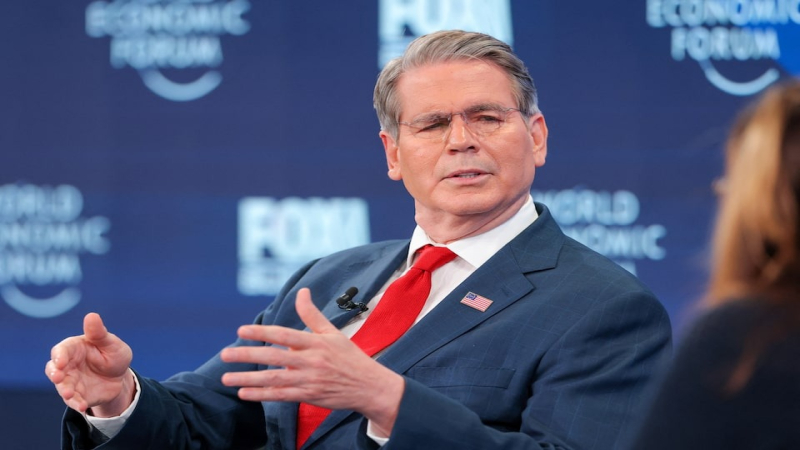
U.S. Treasury Secretary Scott Bessent sought to reassure markets that recent geopolitical tensions and tariff threats would not undermine demand for U.S. government debt, signaling confidence in the resilience of the Treasury market. Speaking on the sidelines of global economic meetings, Bessent downplayed concerns that political disputes involving European allies could trigger a sell off by foreign investors. He emphasized that U.S. Treasury auctions continue to attract strong participation, including record levels of foreign investment, reinforcing the view that Treasuries remain a core global safe asset. The comments come amid heightened market sensitivity to policy signals, with investors closely watching whether trade tensions and diplomatic friction could spill over into financial markets.
Concerns had emerged that disputes linked to trade policy and geopolitical positioning could prompt European institutional investors to reassess their exposure to U.S. debt. Bessent rejected that notion, arguing that holdings from individual countries are not large enough to meaningfully influence the broader Treasury market. He stressed that demand for U.S. government bonds remains deep and diversified, supported by their role in global reserves and financial stability frameworks. The remarks were intended to counter speculation that political rhetoric could erode confidence in U.S. fiscal instruments, a scenario that would carry significant implications for borrowing costs and global liquidity conditions.
The Treasury secretary also pushed back against criticism from European leaders, characterizing some responses as exaggerated and politically motivated. He suggested that fiscal challenges within Europe, rather than U.S. policy direction, should be the primary focus for regional policymakers. By framing the situation this way, Bessent signaled that Washington does not view the current tensions as a systemic risk to financial markets. His comments highlighted the administration’s broader strategy of projecting economic confidence while pursuing assertive trade and geopolitical objectives, even in the face of international pushback.
Beyond the immediate debate over tariffs and diplomacy, Bessent underscored growth as a central pillar of the U.S. economic agenda. He reiterated that policies aimed at expanding economic output would remain a priority, particularly as the United States plays a leading role in global economic coordination. For markets, the message was clear: U.S. officials see no indication that confidence in Treasuries is weakening, despite political noise. As investors assess ongoing volatility tied to trade and foreign policy, reassurance around the stability of U.S. debt markets is likely to remain a key factor supporting broader risk sentiment.