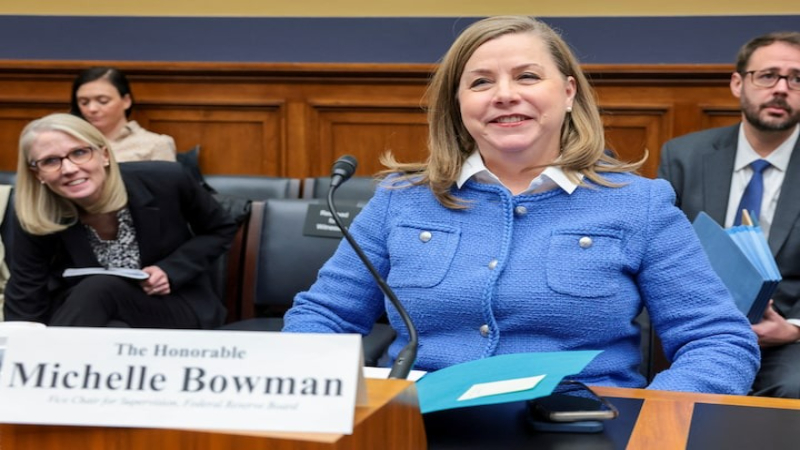
Federal Reserve Vice Chair Michelle Bowman indicated that the central bank should remain prepared to reduce interest rates again if labor market conditions weaken, underscoring growing sensitivity within policy circles to employment risks even as inflation pressures ease. Speaking at a regional economic forum, Bowman stated that the labor market, although still near full employment, has shown signs of fragility that could intensify in the months ahead. She emphasized that without clear and sustained improvement in employment conditions, policymakers should be willing to move monetary policy closer to a neutral stance. Bowman also cautioned against prematurely signaling a pause in rate adjustments, noting that policy flexibility remains critical in an environment where economic conditions can shift rapidly.
Bowman described the current monetary stance as moderately restrictive, reflecting the cumulative impact of rate reductions implemented toward the end of last year. She noted that economic activity is still expanding at a solid pace and expects the labor market to stabilize as borrowing costs gradually become less restrictive. However, she stressed that forecasts must remain forward-looking and grounded in a broad range of indicators, including direct engagement with businesses and communities. In her view, reliance on real-time labor market signals is increasingly important as traditional metrics may lag underlying shifts in hiring behavior and workforce demand.
On inflation, Bowman said price pressures appear to be moving closer to the Federal Reserve’s long term target, supported by easing effects from trade-related costs and more stable supply dynamics. She argued that while inflation risks are becoming more balanced, the risks facing employment are more uneven, tilting policy considerations toward caution. This dynamic helps explain why the central bank is reluctant to rule out further easing, even as officials project relatively modest policy adjustments this year. The Fed has already lowered its benchmark rate substantially, aiming to support employment without abandoning progress on price stability.
Beyond rates, Bowman also highlighted potential vulnerabilities in financial markets, pointing to elevated equity valuations and the possibility of sharp corrections if expectations around technology investment returns disappoint. She added that banking oversight priorities remain focused on improving merger reviews, evaluating capital requirements, and addressing persistent issues such as payments and fraud risks. Taken together, her remarks suggest a Federal Reserve that is increasingly attentive to downside labor market risks while seeking to preserve financial stability and policy credibility in a politically charged environment.