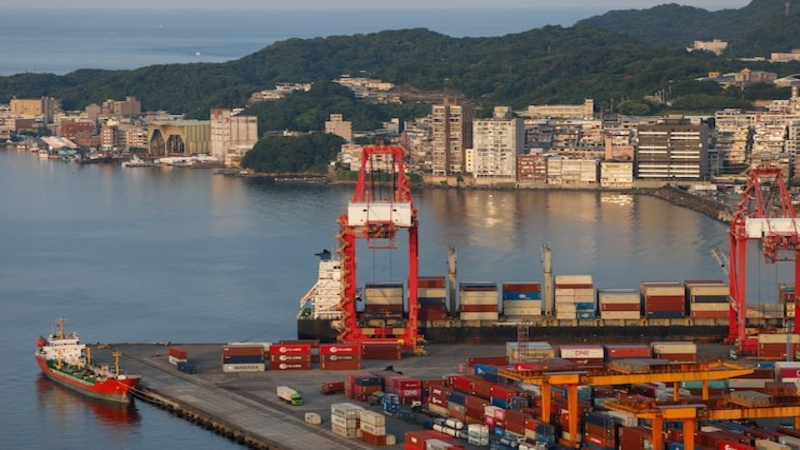
Taiwan closed 2025 with record export performance, highlighting how artificial intelligence demand has become a defining force in global trade dynamics. Overseas shipments reached an all time high, reflecting sustained orders for advanced semiconductors and technology components used in data centers, cloud infrastructure, and high performance computing. While monthly growth moderated slightly toward year end, the overall trajectory underscored the island’s central role in the global technology supply chain. Markets viewed the export figures as confirmation that AI investment remains resilient despite rising geopolitical and trade policy uncertainty. The data also reinforced how export led economies tied to advanced manufacturing continue to outperform peers reliant on traditional industrial or consumer demand. Taiwan’s trade strength has become less cyclical and more structurally linked to long term digital investment trends.
Exports to the United States remained the primary growth engine, posting another outsized increase despite higher tariffs on non semiconductor goods. The scale of shipments reflected deep integration between Taiwan’s chipmakers and US technology firms, with AI infrastructure buildouts driving demand regardless of near term policy frictions. Exports to China also expanded, though at a slower pace, suggesting a partial normalization of regional trade flows alongside ongoing diversification. The composition of exports further highlighted how electronic components dominate Taiwan’s external sector, reinforcing its exposure to global technology cycles rather than consumer driven trade. Import growth lagged export expansion, signaling strong external demand without a corresponding surge in domestic absorption, a dynamic that supports trade balances but also reflects cautious investment behavior outside the tech sector.
Looking ahead, official guidance points to continued strength early in 2026, with export growth expected to remain elevated as AI related orders persist. However, policymakers have flagged rising uncertainty tied to global trade policy shifts and geopolitical tensions. The risk environment remains complex, with potential changes in tariff regimes and supply chain alignment posing longer term challenges. Despite these risks, Taiwan’s export base appears insulated in the near term due to the strategic nature of advanced chips and limited global alternatives. This has allowed exporters to maintain pricing power and order visibility even as broader trade conditions remain uneven. Markets interpret this as a sign that technology driven exports are now operating on a different cycle from traditional manufacturing.
From a macro perspective, Taiwan’s performance illustrates how AI investment is reshaping global trade hierarchies. Export growth is increasingly concentrated in economies that control critical nodes of the digital supply chain, reinforcing asymmetries in trade resilience. For currency and capital flow observers, sustained export surpluses support external stability while deepening exposure to global technology cycles. Taiwan’s experience suggests that growth linked to AI infrastructure may prove more durable than previous tech booms, but also more sensitive to policy and geopolitical shifts. As global demand for computing power accelerates, Taiwan’s export trajectory will remain a key indicator of how investment, trade, and technology intersect in the evolving global economy.