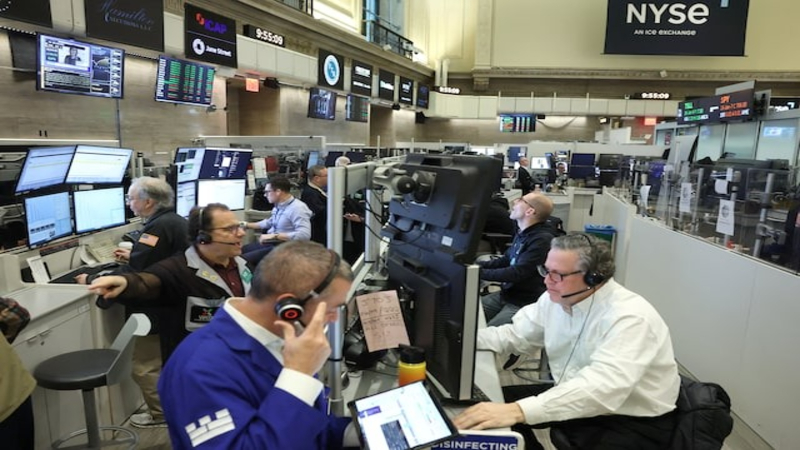
US equities moved modestly higher as investors weighed a softer than expected December labor report against rising legal and policy uncertainty tied to trade. Gains across major indexes reflected a market still anchored to the outlook for US interest rates rather than near term political headlines. Payroll growth undershot forecasts, reinforcing expectations that monetary conditions will ease further into 2026 even as unemployment remained stable. The data signaled cooling momentum rather than a sharp slowdown, which markets interpreted as supportive for risk assets. Equity futures had traded cautiously earlier in the session, but sentiment improved as traders recalibrated rate expectations. The result was a broadly positive session marked by steady participation rather than aggressive positioning, with market breadth favoring advancers and cyclical sensitivity remaining contained.
Interest rate pricing remained the dominant driver, with investors continuing to discount meaningful easing over the year despite a growing consensus that the labor market is not in crisis. Short term rate cut probabilities shifted only marginally, reflecting confidence that policy remains on a gradual normalization path rather than an urgent response to economic stress. Bond yields showed limited volatility, reinforcing the view that financial conditions are loosening slowly rather than abruptly. For currency markets, the data helped cap near term dollar strength without triggering a broader repricing of global FX regimes. The softer employment print reduced upside pressure on yields while leaving the broader macro narrative intact, one in which growth moderates but remains resilient enough to avoid destabilizing capital flows.
Alongside macro data, markets remained alert to an impending Supreme Court ruling on the legality of sweeping trade tariffs. The prospect of a decision introduced a layer of event risk that investors largely chose to defer rather than price aggressively. A ruling that alters the tariff framework could reshape trade leverage and pricing power, with downstream implications for inflation expectations and fiscal assumptions. Equity investors appeared reluctant to reposition ahead of clarity, instead favoring diversified exposure and defensive balance within portfolios. Utilities outperformed as investors rotated toward stable cash flow sectors, while selective gains in technology and industrial names reflected optimism tied to corporate specific developments rather than broad policy shifts.
The session also highlighted how equity performance remains closely linked to expectations around policy coordination rather than single data points. Housing related stocks rallied on renewed attention to mortgage market support, underscoring sensitivity to rate driven affordability dynamics. Elsewhere, sector specific moves reflected capital discipline and long horizon contracts rather than speculative momentum. Overall, the market tone suggested cautious confidence, with investors acknowledging softer growth signals while remaining focused on liquidity conditions and policy continuity. For USD focused observers, the takeaway was a market still governed by rates and institutional credibility rather than short term volatility, a setup that favors measured positioning over directional conviction.