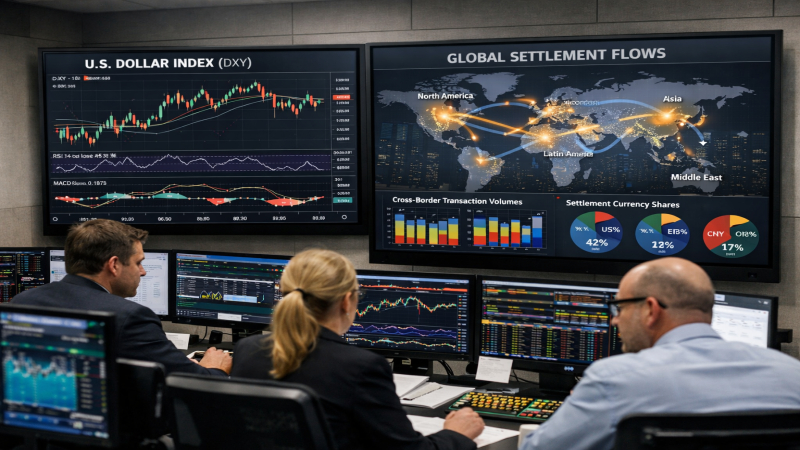
The strength of the US dollar has traditionally been assessed through reserves, trade invoicing, and capital flows. While these indicators remain central, global markets are increasingly influenced by how efficiently transactions settle. Settlement infrastructure is becoming a structural factor in determining how dollar strength is expressed across regions and market cycles.
This evolution does not signal a loss of confidence in the dollar. Instead, it reflects a shift in how global finance measures reliability and access. As modern settlement models integrate into cross border systems, dollar strength is being evaluated not only by demand, but by how smoothly it moves through the global economy.
Dollar Strength Beyond Traditional Reserve Metrics
For decades, dollar strength has been associated with reserve holdings and safe haven demand. These indicators remain relevant, particularly during periods of uncertainty. However, operational factors now play a larger role in shaping short term market behavior.
Settlement efficiency affects how quickly capital responds to policy changes and risk events. Faster clearing reduces friction and allows dollar liquidity to circulate more dynamically. This creates a system where strength is reflected in usability rather than exclusivity.
As a result, dollar influence is increasingly reinforced by infrastructure that supports speed and reliability.
Liquidity Timing and Market Responsiveness
Liquidity timing has become a critical consideration for forex markets. When settlement processes are slow, liquidity tends to accumulate in advance, leading to distortions and temporary shortages. Improved settlement tools allow institutions to rely on access rather than pre funding, changing how liquidity is distributed throughout the trading day.
This responsiveness can amplify market reactions to economic data and policy signals. Dollar liquidity adjusts more rapidly, making short term price movements more sensitive to real time developments. For traders, this increases the importance of understanding settlement mechanics alongside macro fundamentals.
Over time, liquidity timing is becoming as important as liquidity volume.
Trade Settlement and Operational Confidence
Global trade remains anchored to the dollar for pricing, particularly in commodities and large scale supply chains. What is evolving is the operational layer that completes these transactions. Companies increasingly prioritize settlement certainty and cost efficiency to manage working capital more effectively.
By maintaining dollar benchmarks while adopting modern clearing solutions, firms enhance operational confidence without altering pricing structures. This strengthens the dollar’s role by making it easier to use across diverse markets and transaction sizes.
Operational confidence reinforces currency strength in ways that traditional metrics may not fully capture.
Infrastructure Neutrality and Global Access
Infrastructure neutrality has emerged as a theme in global settlement discussions. Neutral settlement layers reduce dependence on any single geographic or institutional pathway while maintaining alignment with established currencies. This supports broader market participation without challenging monetary anchors.
For the dollar, neutrality can be an advantage. It allows the currency to function as a global reference while benefiting from diversified execution channels. This combination supports resilience during periods of geopolitical or financial stress.
Markets increasingly view neutrality as a feature of strength rather than a sign of fragmentation.
Implications for Future Dollar Cycles
Dollar cycles have historically been shaped by interest rate differentials and global risk sentiment. While these drivers remain intact, settlement infrastructure now influences how quickly and efficiently these forces translate into market action.
As settlement innovation continues, future dollar cycles may become more compressed and responsive. Strength will be reflected in adaptability as much as in scale. This evolution suggests continuity rather than disruption, with the dollar maintaining its central role within a modernized system.
For analysts, infrastructure awareness is becoming essential to understanding cycle dynamics.
Conclusion
Settlement innovation is redefining how global markets measure dollar strength by emphasizing efficiency, access, and responsiveness. The US dollar remains the foundation of global finance, but its influence is increasingly expressed through modern settlement architecture. This shift reflects adaptation to a faster, more interconnected economy, reinforcing dollar strength through integration rather than exclusivity.