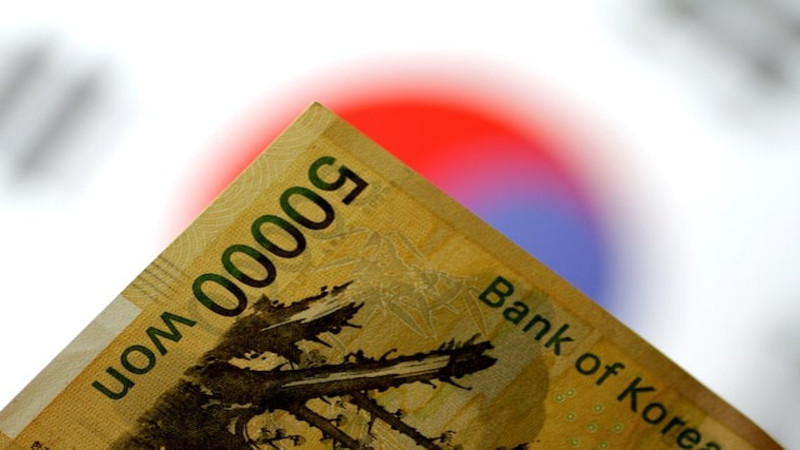
South Korea’s currency opened 2026 under renewed pressure, with the won weakening further against the dollar despite fresh efforts by authorities to stabilize foreign exchange markets. The move comes as policymakers grow increasingly vocal about what they see as a disconnect between the currency’s valuation and underlying economic fundamentals. With the won trading near levels last seen more than a decade ago, officials have sought to reframe the narrative away from domestic weakness and toward structural capital flow dynamics. A wide interest rate gap with the United States has encouraged persistent demand for dollars among Korean investors, amplifying depreciation pressures even as local growth and external balances remain relatively stable. The start of the year has therefore placed currency management back at the center of Korea’s macro policy agenda, highlighting the challenge of navigating global rate divergence.
Central bank officials have pointed to institutional investment behavior as a key contributor to recent moves in the exchange rate. Large overseas allocations by domestic investors, including public pension funds, have increased dollar demand and added volatility to the spot market. Policymakers have signaled that while international diversification remains a long term objective, its short term impact on currency stability must be managed carefully. This has prompted calls for a reassessment of investment pacing and coordination between fiscal authorities and large institutional investors. At the same time, officials have emphasized that exchange rate levels should not be interpreted as a referendum on economic health, pushing back against market narratives that equate currency weakness with deteriorating fundamentals. This messaging reflects a broader effort to anchor expectations and discourage speculative behavior during periods of thin liquidity.
Government measures to support the won have expanded beyond verbal guidance. Authorities are preparing new tax incentives aimed at attracting foreign capital back into local equity markets, while also tightening oversight of speculative FX positioning. These steps are designed to improve balance in capital flows without resorting to direct intervention, which carries diplomatic and market risks. Coordination with trade partners has also become part of the currency strategy, particularly as outbound investment commitments linked to bilateral agreements are phased in gradually to limit near term pressure. Market participants view these measures as an attempt to smooth volatility rather than engineer a sharp reversal, signaling that policymakers are prioritizing stability over a specific exchange rate target. This approach underscores the delicate balance between openness and control in an increasingly interconnected financial system.
The won’s performance early in the year illustrates the broader challenge facing mid sized open economies in a dollar dominated system. As global investors respond to relative yield and policy signals, exchange rates can overshoot levels implied by domestic conditions, complicating monetary management. For South Korea, the task is not only to arrest further weakness but to restore confidence that currency moves will remain orderly as global conditions evolve. While officials remain confident that fundamentals will ultimately reassert themselves, the near term outlook is shaped by external forces largely beyond domestic control. As 2026 unfolds, the won is likely to remain a focal point for policymakers testing the limits of coordination, communication, and market credibility.