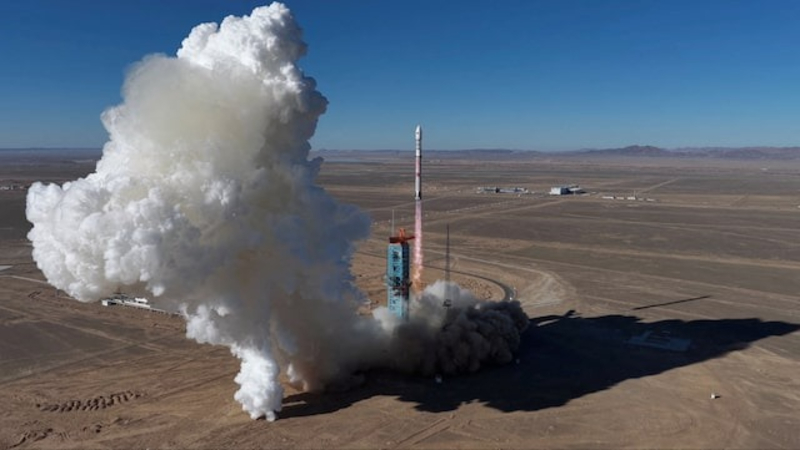
China has moved to accelerate funding access for its emerging commercial space sector by easing initial public offering rules for companies developing reusable rocket technology. Under new guidelines, eligible firms will be able to list on the country’s technology focused equity market without meeting traditional profitability or revenue thresholds, marking a strategic shift in how Beijing channels capital into priority industries. The policy underscores a growing willingness to tolerate early stage financial risk in exchange for technological progress, particularly in areas seen as strategically sensitive. By linking market access to technical milestones rather than balance sheet performance, regulators are signaling that innovation capacity now outweighs near term earnings in determining which firms gain access to public funding.
The revised framework places emphasis on demonstrated technical capability, requiring companies to achieve key development benchmarks such as a successful orbital launch using reusable rocket systems. This approach reflects the capital intensive and long gestation nature of advanced aerospace projects, where upfront investment is heavy and commercial returns remain distant. Authorities appear focused on ensuring that firms entering public markets possess credible engineering progress rather than speculative concepts. The move builds on earlier efforts to broaden capital market access for pre profit technology companies, reinforcing a model in which financial markets are used as instruments of industrial policy rather than purely valuation driven platforms.
Beijing’s motivation is closely tied to global competition in space technology, where reusable launch systems have become a defining advantage. The ability to recover and reuse rocket components has reshaped cost structures and launch frequency, altering the economics of satellite deployment. Chinese policymakers have repeatedly framed dependence on foreign launch capabilities as a strategic vulnerability, prompting increased support for domestic alternatives. Recent test launches by private Chinese firms have demonstrated progress, even as full recovery capabilities remain a work in progress. By lowering listing barriers, regulators aim to ensure that promising firms can sustain development cycles without relying solely on state funding.
The guidelines also prioritize companies involved in national missions or major state backed projects, highlighting the close alignment between commercial space activity and broader strategic objectives. This integration of private capital, public markets, and national goals reflects a distinctive model of technology development. For investors, the policy introduces new opportunities alongside elevated risk, as valuations will hinge more on execution and technological delivery than on near term financial metrics. As China pushes to scale its space ambitions, capital markets are being positioned as a central tool in narrowing the technological gap with established global leaders.