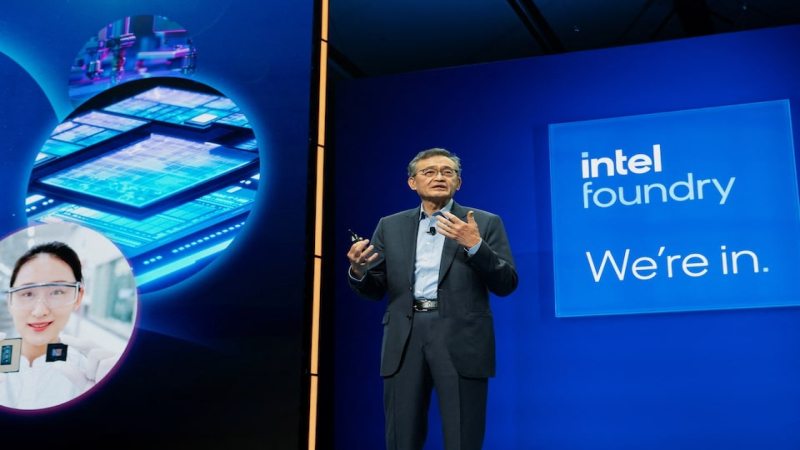
A sharp political confrontation unexpectedly reshaped the future of one of America’s most important semiconductor companies, illustrating how corporate strategy and state power are becoming increasingly intertwined. Intel’s leadership found itself under public pressure after concerns were raised about foreign exposure and strategic alignment, forcing a rapid recalibration of its engagement with Washington. What followed was an accelerated effort to reposition the company not merely as a technology firm, but as a strategic national asset. The outcome marked a turning point, signaling a broader shift in how industrial capability, national security, and capital allocation intersect in the current policy environment. Rather than focusing solely on operational recovery, Intel’s leadership moved to secure political legitimacy as a prerequisite for long-term survival.
The resulting agreement between the company and the U.S. government delivered more than capital support. A substantial equity stake by the state effectively reframed Intel as too strategically important to fail, altering market perception and competitive dynamics. This backing strengthened Intel’s position in negotiations with partners and suppliers, while also placing it within a growing category of firms aligned with explicit national industrial objectives. The move reflects an evolving framework in which government participation is no longer limited to subsidies or tax incentives, but extends directly into ownership and influence. For investors, the deal introduced a new layer of support, but also tied the company’s future more closely to political priorities and policy continuity.
Market reaction has been favorable, with Intel’s shares sharply outperforming broader equity benchmarks since the leadership transition. This surge reflects optimism that political backing can stabilize long-term investment plans and reduce existential risk in an industry dominated by global competition and high capital intensity. However, questions remain about whether financial and political leverage alone can resolve deep technical challenges. Intel continues to face pressure from rivals that have advanced more quickly in manufacturing efficiency and artificial intelligence integration. While dealmaking has secured time and capital, execution in process technology and product strategy will determine whether the company can translate political support into sustainable competitiveness.
More broadly, the episode highlights a structural shift in U.S. economic policy toward selective intervention in sectors deemed strategically vital. Semiconductor manufacturing now sits alongside energy and defense as an area where market forces alone are no longer viewed as sufficient. The willingness of the government to take equity positions suggests a recalibration of capitalism rather than a retreat from it, blending public authority with private enterprise. For technology firms operating at the intersection of innovation and geopolitics, success increasingly depends not only on engineering excellence but also on navigating policy alignment in an era where economic sovereignty has become a central priority.