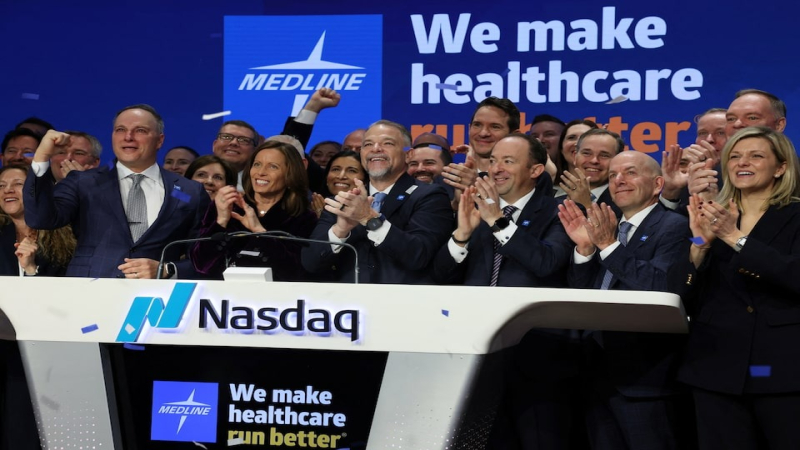
Medline’s strong Nasdaq debut has become a key signal in how capital markets are recalibrating risk appetite amid shifting dollar and rate dynamics. Shares of the medical supplies giant opened sharply above their offering price, lifting its valuation to roughly $46 billion and marking the largest U.S. initial public offering since 2021. The scale and reception of the deal stand out less for sector enthusiasm and more for what they suggest about investor willingness to absorb large equity issuance after a prolonged period of higher rates and balance sheet tightening. Unlike growth driven listings that rely heavily on future expectations, Medline entered the market with an established cash flow profile, reinforcing demand for issuers that align with tighter financial conditions. The transaction reflects a selective reopening of primary markets where pricing discipline and profitability are again central to capital allocation decisions.
The listing also underscores how private equity backed exits are reemerging as financing constraints stabilize. Medline’s offering allowed sponsors to reduce leverage accumulated during an era of low rates, highlighting how equity markets are being used to rebalance capital structures shaped by earlier monetary policy cycles. From a macro perspective, this matters because large IPOs act as a pressure valve for private capital that accumulated during periods of abundant liquidity. The ability to execute a deal of this size suggests that equity investors are increasingly comfortable underwriting risk even as policy uncertainty persists around tariffs, government spending, and global trade. Medline’s exposure to supply chains affected by tariffs did little to dampen demand, indicating that markets are prioritizing earnings durability and balance sheet repair over headline policy risks.
More broadly, the Medline debut feeds into a larger narrative about the interaction between rates, the dollar, and capital formation. U.S. IPO issuance has remained resilient through 2025 despite volatility tied to fiscal disruptions and trade measures, pointing to a market that is adapting rather than retreating. As Treasury yields remain elevated relative to prior cycles, equity investors appear more selective but not absent, favoring issuers that can function under tighter liquidity conditions. The successful offering also strengthens expectations for a fuller IPO pipeline in 2026, particularly among mature private firms waiting for clearer signals from policy and funding markets. For dollar observers, the transaction serves as an indicator that domestic capital markets are regaining depth even as global conditions remain uneven, reinforcing the United States’ role as a primary destination for large scale equity financing.