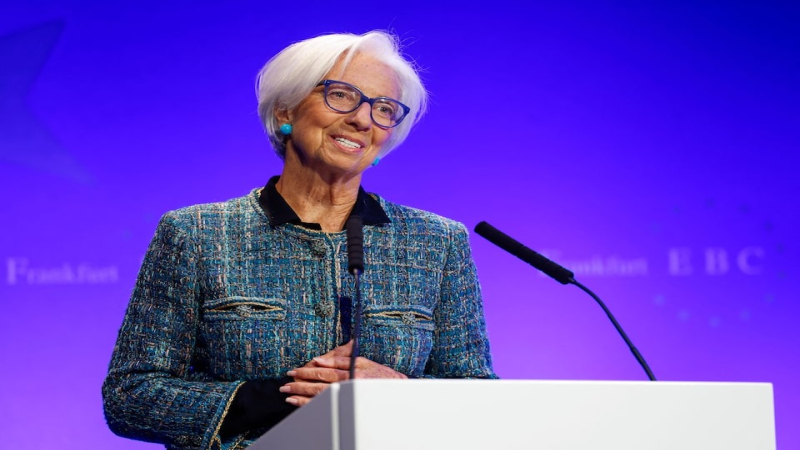
Top European Central Bank officials pressed the European Union to dismantle long-standing internal trade barriers, arguing that stronger integration within the bloc could offset the economic drag created by new U.S. tariffs and broader deglobalisation trends. Speaking at a major financial conference in Frankfurt, policymakers emphasized that Europe’s competitiveness problem is now rooted less in external shocks and more in structural fragmentation that limits the scale and efficiency of its companies. They noted that complex regulatory differences across the 27-member bloc have weakened the region’s ability to respond to rising global trade frictions, leaving EU firms at a disadvantage compared with larger U.S. rivals that operate under a uniform legal framework. The ECB’s analysis suggested that reducing internal trade barriers even partially would boost cross-border activity enough to counter the negative effects of U.S. trade measures on growth, highlighting how internal alignment could serve as a macroeconomic stabilizer during periods of geopolitical tension. For USD focused observers, the discussion underscores how transatlantic tariff dynamics may influence future investment flows and structural shifts within the global economy.
Officials stressed that the EU’s structural rigidities directly limit the emergence of large globally competitive companies. Many European firms fall between two extremes: too large to innovate with the agility of smaller enterprises but too small to enjoy the economies of scale seen in U.S. corporations. German and ECB leaders reiterated calls for a “28th regime,” a voluntary uniform legal framework available to companies seeking simpler and more predictable rules across all member states. Such a regime would circumvent the political hurdles associated with full harmonisation while still easing compliance burdens and enabling businesses to scale more efficiently. Policymakers argued that this approach would lower operational costs, reduce legal complexity and provide firms with the structural clarity needed to operate in an increasingly competitive global marketplace. Reducing fragmentation, they said, could also improve capital allocation, boost productivity and enhance the EU’s ability to respond to external shocks such as shifting U.S. tariff policies or supply chain disruptions.
The officials also highlighted capital outflow as a growing concern, noting that euro area households hold more than six trillion euros in U.S. equities, roughly double the level from a decade ago. The trend reflects both the search for higher returns and persistent doubts about Europe’s long term growth potential. Leaders argued that lowering internal barriers would help mobilize this capital at home by making it easier for promising companies to access pan-European financing. They further urged reforms such as harmonizing value-added taxes and expanding qualified majority voting to reduce the frequency of veto-driven policy gridlock. While acknowledging the role fiscal measures have played in buffering recent economic strains, officials emphasized that monetary policy would continue adjusting to maintain inflation stability. For analysts monitoring USD dynamics, the message signals that Europe’s structural challenges remain a key variable in global capital flows. Without meaningful reform, investors may continue favoring U.S. markets, strengthening the dollar’s relative appeal during periods of policy uncertainty and economic divergence.