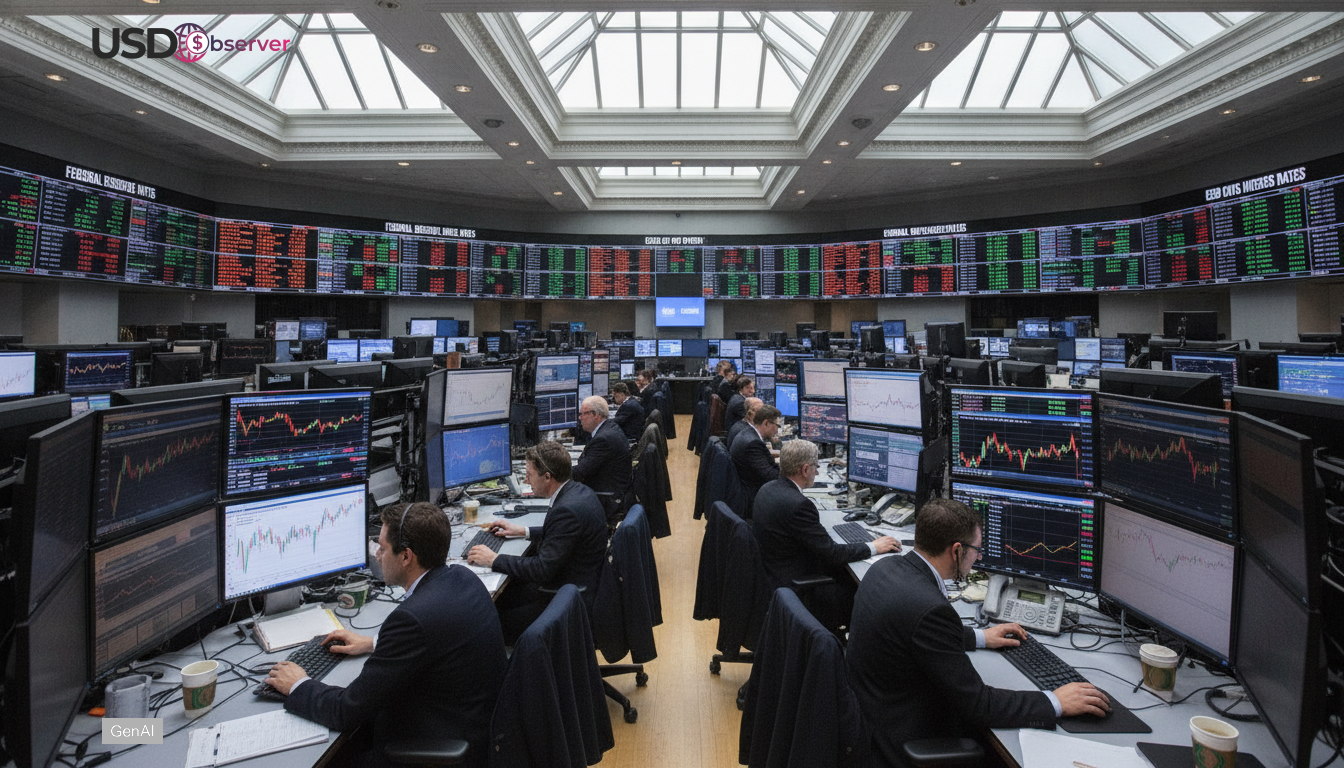
Global markets are closing out a volatile year with surprising calm as investors navigate a challenging macro backdrop marked by policy uncertainty, shifting monetary expectations and a series of disruptive global events. Despite widespread concerns following Washington’s attempts to reshape international trade rules earlier in the year and the turbulence surrounding sudden tariff actions, equities and bonds have demonstrated a resilience that has surprised many analysts. Major indices continue to show strong year to date gains, supported by second half global growth figures that have exceeded 3 percent and lending confidence to risk taking across multiple asset classes. Measures of implied volatility remain subdued even with concerns over political unpredictability and the absence of consistent data releases during the prolonged US government shutdown. For investors focused on USD dynamics, the stability in risk assets is particularly notable as it runs counter to the tone of caution voiced by policymakers, banks and institutional asset managers throughout much of 2025.
A deeper look into market structure suggests that part of the calm may be tied to a wave of speculative activity surrounding high volatility stocks, many of which have seen outsize gains in recent months. Analysts have pointed to a rally in lower quality equities, especially in small cap segments, that reflects speculative enthusiasm reminiscent of retail driven trading episodes earlier in the decade. Options activity has increasingly concentrated in these names, reducing implied volatility pressures on major indices and creating a disconnect between underlying fundamentals and surface level market stability. At the same time, expansionary fiscal policy in major economies has helped support top line growth, even if it does not fully explain why volatility gauges like the VIX and Treasury based MOVE index remain suppressed. As markets wait for a flood of postponed economic data to be released, many question whether the current calm can persist when investors finally receive a complete view of US momentum, inflation signals and evolving labor conditions.
Another factor credited with the resilience of financial markets is the sheer scale of global liquidity still circulating through the system. Large increases in personal wealth over the past two decades have left households and investors with substantial capacity to absorb shocks and buy into downturns. Wealth reports show trillions in assets held by a rapidly expanding class of affluent individuals, creating a foundation of demand that often stabilizes markets during periods of uncertainty. The long standing habit of buying dips has been reinforced by years of policy responses that softened volatility, contributing to the belief that deep and sustained corrections are increasingly rare. While this dynamic helps explain the market’s ability to withstand political turbulence and unconventional monetary periods, it also raises questions about how the system would respond if an unusually large shock tested this confidence. For USD watchers, the overall picture reflects a global financial environment that appears steady on the surface but is supported by complex underlying forces that continue to evolve.