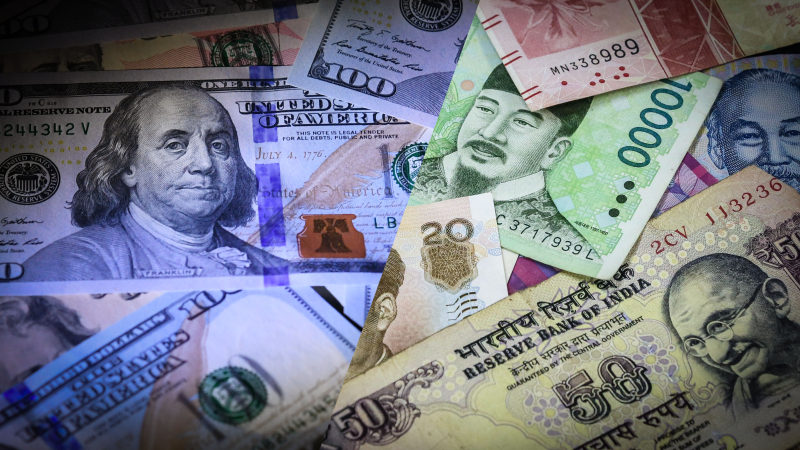
Asian currency markets are under renewed strain as the U.S. dollar continues to strengthen on the back of resilient American growth and persistent inflationary pressures. Both the Chinese yuan and the Indian rupee have fallen to multi-month lows, reflecting a wider regional trend of depreciation against the greenback. The shift underscores the global impact of the Federal Reserve’s extended period of tight monetary policy, which is drawing capital flows back toward U.S. assets.
The move has created difficult trade-offs for Asian policymakers. On one hand, a weaker currency can boost export competitiveness, particularly for manufacturing-heavy economies such as China and India. On the other hand, it raises the cost of imports, fuels inflation, and tightens local liquidity conditions. The result is a complex balancing act between maintaining stability and supporting growth amid global monetary divergence.
Yuan under pressure as China battles soft growth
The Chinese yuan has been one of the most closely watched currencies this quarter. Despite efforts by the People’s Bank of China to guide the yuan through a stable midpoint fixing, persistent outflows and a widening yield gap with the United States have pushed the currency weaker. The differential between U.S. and Chinese interest rates remains substantial, encouraging investors to move capital offshore in search of higher returns.
China’s economic slowdown has added another layer of pressure. Soft industrial production, muted consumer demand, and a sluggish property sector have weighed on sentiment. Policymakers are reluctant to deploy aggressive stimulus, mindful of financial stability risks, which leaves limited options to defend the currency. Market analysts note that the PBOC’s interventions, while steady, have not been large enough to counter persistent dollar demand from corporates and investors hedging exposure.
Foreign exchange reserves remain ample, but the psychological impact of a weakening yuan is becoming more visible in equity and bond markets. The depreciation has also complicated China’s trade relationships, as regional partners face competitive devaluations to maintain export margins.
Rupee weakness highlights capital flow challenges.
India’s rupee has also come under sustained pressure, trading near its lowest level in over a year. While India’s economy remains one of the fastest-growing globally, strong dollar dynamics and rising oil import costs have eroded confidence in the currency. The Reserve Bank of India (RBI) has been intervening periodically to smooth volatility, selling dollars from its reserves to slow the pace of depreciation.
Unlike China, India’s external position is more sensitive to commodity prices. A stronger dollar increases the cost of oil imports, widening the current account deficit and straining balance-of-payments stability. That dynamic feeds into inflation and complicates the RBI’s rate management strategy. Market participants suggest that the central bank’s approach will remain tactical, prioritizing currency stability while avoiding excessive reserve depletion.
Foreign portfolio investors have turned cautious amid high U.S. yields. The reversal of capital inflows into Indian equities and bonds is consistent with previous tightening cycles, where global investors favor dollar-denominated assets over emerging market exposure.
Regional contagion and global implications
Beyond China and India, several other Asian currencies, including the South Korean won, Indonesian rupiah, and Thai baht, have also weakened under the weight of a strong dollar. The synchronized nature of these moves reflects how global liquidity conditions are transmitted across emerging markets. When U.S. yields rise, risk appetite falls, forcing investors to unwind leveraged positions in higher-yielding Asian assets.
The regional selloff highlights the enduring dominance of the dollar in global finance. Even as countries diversify trade settlement mechanisms or explore alternative reserve holdings, their currencies remain deeply tied to dollar movements. For exporters, the weaker local currency may bring temporary relief, but for importers and consumers, it means higher prices and tighter financial conditions.
Policymakers across Asia are facing a delicate balancing act. Coordinated communication and prudent reserve management have become critical to preventing disorderly market adjustments. Some economies have also stepped up bilateral currency swap lines to cushion short-term funding stress. However, unless the Federal Reserve signals a clear pivot, Asian currencies are likely to remain under pressure.
Conclusion
The yuan and rupee underscore how dependent Asia remains on global dollar liquidity. With the Federal Reserve keeping rates elevated and the U.S. economy outperforming, regional currencies are adjusting to a new normal of tighter financial conditions. For now, the strong dollar remains both a reflection of U.S. resilience and a source of strain for emerging markets.