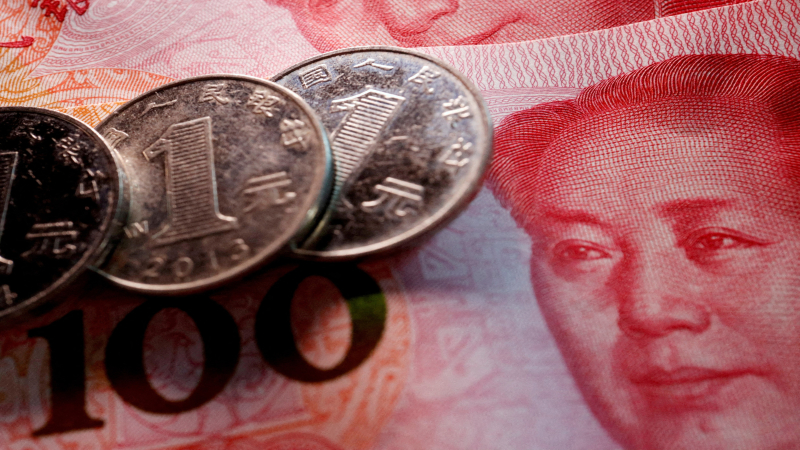
China’s yuan has weakened to around 7.4 per U.S. dollar, marking one of its softest levels in more than a year. The slide reflects a mix of domestic challenges and external forces, including a strong U.S. dollar and sluggish global demand. For Beijing, the currency’s performance is now a mirror of its broader economic adjustments and policy balancing acts.
The yuan’s weakness comes as growth momentum in China remains uneven. Industrial output and retail data show modest improvement, yet real-estate investment and private confidence continue to lag. These dynamics are feeding into the currency’s value, creating persistent depreciation pressure despite attempts to stabilize sentiment.
For the People’s Bank of China (PBoC), the focus is not just on the exchange rate itself but on how it influences liquidity, capital movement, and public confidence. Managing volatility has become essential to ensure that currency fluctuations do not spill over into financial instability.
Exchange Rate Management and Controlled Weakening
The PBoC continues to guide the yuan through its daily midpoint fixing mechanism, keeping its movement within a limited band. In recent weeks, the bank has allowed slightly weaker fixings, indicating a tolerance for gradual depreciation while signalling that sharp declines will not be accepted. This approach reflects a deliberate balance between supporting exports and maintaining market order.
A weaker yuan can improve the competitiveness of Chinese goods in international markets. Exporters benefit when their products become cheaper in dollar terms, a factor that helps offset weaker domestic consumption. However, this same dynamic raises import costs and squeezes margins for companies that rely heavily on foreign raw materials and energy.
The PBoC’s challenge is therefore one of calibration. Too much intervention risks depleting reserves and fuelling speculation that authorities are defending a line in the sand. Too little oversight could trigger volatility, accelerate capital flight, and undermine confidence in the stability of China’s currency regime.
Capital Outflow Risks and External Financing Pressures
One of Beijing’s biggest concerns is the potential for rising capital outflows as the yuan weakens. Companies and investors often move money abroad when local assets depreciate, amplifying exchange-rate pressure. That dynamic is particularly relevant today, given China’s vast pool of corporate dollar liabilities and globalized investor base.
Recent financial data show an increase in foreign-exchange deposits held by Chinese firms. Businesses are hoarding dollars to hedge against further yuan depreciation, and some are accelerating offshore investment plans. This behaviour adds to downward momentum, effectively reinforcing the depreciation trend the PBoC is working to contain.
Outflow risks also tie into China’s broader capital-account structure. While capital controls remain in place, financial channels through Hong Kong, Singapore, and offshore bond markets provide partial escape valves for investors. Managing these flows has become a delicate task, as excessive tightening could discourage foreign investment while excessive freedom could invite instability.
Another layer of risk lies in consumer and investor psychology. When households perceive the currency to be on a one-way path, they often rush to convert savings or increase foreign purchases. This sentiment-driven behaviour can magnify downward pressure and complicate policy responses.
Domestic and External Policy Interplay
The currency’s direction cannot be separated from China’s domestic macroeconomic story. The government continues to prioritize stable employment, manageable inflation, and export support, all of which influence monetary flexibility. Fiscal stimulus measures and credit easing provide short-term support but can also put further pressure on the exchange rate if they dilute real yields.
Externally, China is facing a difficult environment. The U.S. dollar remains firm, underpinned by strong economic data and high yields, while Japan and Europe maintain more accommodative policies. This divergence leaves limited room for the yuan to appreciate, as global capital continues flowing toward higher-yielding U.S. assets.
Trade dynamics add another layer of complexity. While exports remain steady, import costs are rising due to the stronger dollar. That squeezes profit margins and adds inflationary pressure domestically, creating a feedback loop that ties monetary policy closer to exchange-rate management.
Outlook and Strategic Scenarios
Looking ahead, the yuan’s near-term path depends on two major variables: China’s growth trajectory and global dollar momentum. If U.S. yields remain elevated and Chinese growth lags, the yuan could continue drifting within the 7.4 to 7.5 range. If China’s economic indicators improve or the dollar softens, modest appreciation could follow.
Most analysts expect the PBoC to continue its strategy of gradual management. Allowing controlled depreciation gives exporters breathing room without triggering panic. The bank may also rely on state-owned lenders to stabilize offshore yuan liquidity, a method it has used effectively in past episodes of market stress.
In the medium term, policymakers are likely to focus on improving capital-market confidence. That means encouraging foreign participation in bond markets, easing investment restrictions, and maintaining a predictable currency policy. Stability remains the cornerstone of China’s financial strategy, even as flexibility becomes more necessary in a world of shifting capital flows.
Conclusion
The yuan’s decline toward 7.4 per U.S. dollar underscores China’s ongoing balancing act between growth support and financial stability. The PBoC’s approach of controlled weakening seeks to maintain market order while allowing enough room for adjustment. Yet, as global and domestic pressures persist, the currency will continue to test the limits of policy coordination.
For investors and policymakers, the yuan remains more than a local concern; it is a key indicator of how the world’s second-largest economy is navigating a complex, shifting global environment. The next few months will reveal whether China can contain volatility without compromising its broader economic goals.