Chevron’s Strategy in Importing Venezuelan Oil
Venezuelan oil imports have re entered the conversation as Chevron adjusts supply plans to fit shifting compliance boundaries and feedstock needs. Today, the company’s approach is less about headline volume and more about matching heavy crude characteristics with specific plant configurations while staying inside current authorizations. The operational play centers on disciplined cargo scheduling, documentation, and payment structures that reduce exposure to policy reversals and counterpart risks. Live market pricing for similar heavy grades has kept refiners focused on margin protection, and Chevron’s trading and logistics teams are treating each arrival as a managed event rather than a standing pipeline. This strategy also signals that energy policy can reshape flows without eliminating demand for compatible barrels.
Impact on US Refinery Operations
For US refineries that are built to run heavier, higher sulfur crude, renewed access to Venezuelan barrels can improve unit utilization and cut costly blend adjustments. Update cycles inside refinery planning now account for variability in arrival windows, assay details, and the downstream impacts on coker feed and distillate yields. That is why plant managers are leaning on near term optimization rather than long range reconfiguration, keeping turnarounds and catalyst choices aligned with the crude slate in front of them. In parallel, broader market attention to risk controls has intensified across commodity finance, reflected in how capital allocators talk about collateral, settlement, and transparency, themes also discussed in coverage of proposed reserve and risk controls for issuers. Even with this context, refinery economics still come down to reliable delivery and predictable quality.
Economic Implications of Venezuelan Oil Imports
In economic terms, Venezuelan oil imports can influence regional differentials rather than reset national price levels, because the barrels mainly compete within the heavy sour segment. Chevron’s participation can tighten or loosen local spreads depending on how much alternative supply is displaced, which matters for refiners that hedge crack spreads and manage working capital in USD. Today, traders watch the link between crude differentials and product inventories, especially when diesel margins soften or gasoline demand rotates by season. Live shipping costs, insurance premiums, and port fees remain decisive in landed cost calculations, so the headline price is only the opening number. Update sensitivity is also higher when compliance signals shift, since a small change in allowable counterparties can widen basis risk and prompt refiners to reroute purchases quickly.
Environmental Considerations Surrounding Crude Processing
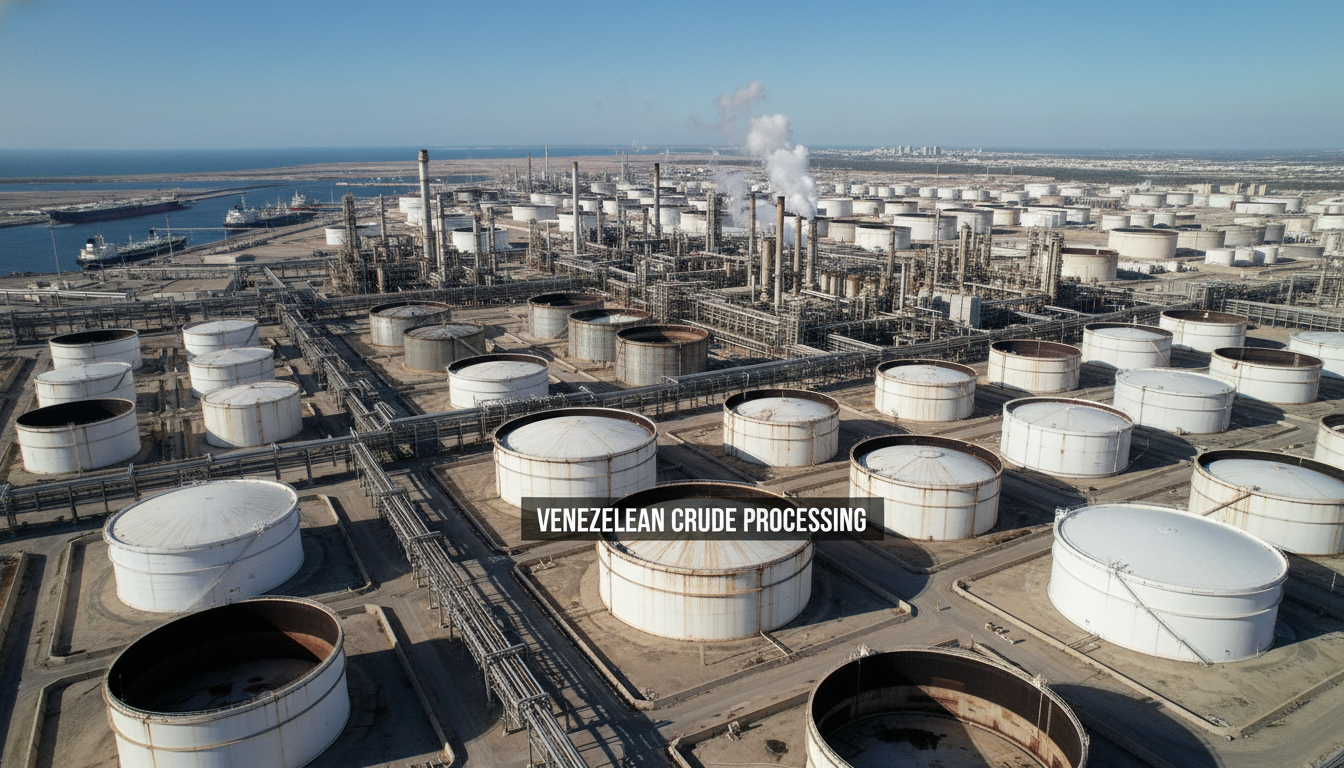
Environmental pressure on crude oil processing is sharpening at the facility level, where emissions intensity is measured in the units that handle heavy crude, including cokers, sulfur recovery, and hydrogen systems. US refineries processing heavier feedstocks often face higher energy use per barrel, pushing operators to pursue efficiency gains, flare minimization, and tighter monitoring to meet permit conditions. Live reporting regimes, including continuous emissions systems, make deviations easier to spot and costlier to correct, so compliance teams are embedding environmental checks into daily crude selection. Update expectations from regulators and local stakeholders also shape how operators discuss incremental barrels, because the optics of heavier crude can be sensitive even when overall throughput is unchanged. For background on how newsrooms are framing environmental oversight and accountability, BBC reporting on policy and regulatory enforcement provides useful context for public scrutiny dynamics.
Future Outlook for US-Venezuela Oil Relations
The future path for US Venezuela oil relations will be determined by how energy policy is enforced in practice, not by rhetoric, and Chevron’s flows will likely mirror that reality through cautious, compliance first execution. Live signals that matter most include the clarity of licensing language, the treatment of service providers, and the consistency of approvals that affect shipping, inspections, and payment channels. Update driven uncertainty tends to raise transaction costs, which can dampen appetite among smaller buyers even if headline permissions exist. At the same time, refiners will continue to chase the best crude fit for their hardware, and heavy grades remain valuable where cokers and desulfurization capacity are underused. Related cross market risk thinking is also visible in broader coverage of price discovery tools and forecast culture, as seen in analysis of prediction market forecasts reaching wider audiences, and in commodities risk coverage tied to geopolitical stress that keeps macro hedging in focus.